

BC bud means cannabis flower grown in British Columbia. It is a place-based nickname, not a strain, and it does not guarantee any level of potency or quality. Over the decades it grew into shorthand for high-grade Canadian weed in general. Below you’ll find where the term came from, why it stuck, and how to judge a product by its label instead of its reputation.
TL;DR
- “BC bud” is a nickname for cannabis from British Columbia. Per the U.S. Department of Justice, it first meant sinsemilla grown there and later came to mean any high-grade Canadian marijuana.
- It is not one strain. Indica, sativa and hybrid cultivars can all be “BC bud”.
- The name is a reputation, not a grade. No regulator certifies it, so the THC and CBD figures on the package matter more.
- In Canada, check for an excise stamp, the standardized THC symbol, a health warning and child-resistant packaging before you trust any product.
- Comparing batches by lab results beats comparing them by slogan.
Table of Contents
- What does BC bud mean?
- Where the name comes from
- Is BC bud a strain?
- Does “BC bud” guarantee quality or potency?
- Why legal status matters more than origin
- Is “bud” a Canadian thing?
- Perspective: how we think about the BC bud name
- Shopping for flower and more at Bulk Cheap Weed
- How to talk about weed origin without getting fooled
- FAQ
- Sources
What does BC bud mean?
The “BC” is British Columbia, Canada’s most westerly province. “Bud” is the everyday word for the flower of the cannabis plant, the part people smoke, vaporize or use to make extracts. So “BC bud” is, literally, flower from BC.
In practice the phrase carries more than geography. Say it to a cannabis buyer and they hear “strong, well-grown, probably indoor.” That reputation is the whole point of the term, and it was earned over several decades before legalization.
A note on the word “bud” itself: the Georgia Straight points out that calling the flower a “bud” is horticulturally inaccurate, but the word is what the community adopted, and it has stuck. The Ontario Cannabis Store uses it the same way, as the consumable flower of the plant.
Where the name comes from
The U.S. Department of Justice’s Washington Drug Threat Assessment states that BC bud originally referred to sinsemilla grown in British Columbia. Sinsemilla is cannabis grown without seeds, which concentrates the plant’s energy in the flower. Over time the label broadened until it became synonymous with any high-grade marijuana from Canada.
The province’s reputation has a recognizable backstory:
- The 1960s and 1970s. The Globe and Mail notes that American draft dodgers who moved to B.C. heavily influenced the province’s cannabis reputation. The Georgia Straight places the adoption of the moniker by the community roughly 30 years after 1931, amid the arrival of those draft objectors.
- Indoor growing. BC Magazine reports that indoor grow-ops produced pot up to 10 times as powerful as the 1970s Mexican weed. That jump in strength is a big part of why the name became a mark of quality.
- Scale. By the early 1990s, authorities estimated that B.C. had about 17,000 grow-ops producing 2,000 tonnes of cannabis a year, according to the same BC Magazine piece.
Matt Lang, quoted in the Georgia Straight, argues that B.C. cannabis built its reputation on quality well before legalization. That is worth remembering: the brand was built in the unregulated era, with no testing labs and no labels behind it.
Is BC bud a strain?
No. This is the most common mix-up, and it is also one of the questions Google surfaces for this search.

Merry Jane explains that the term refers to cannabis strains grown in British Columbia rather than to one particular strain, and that its association with quality comes from the region’s reputation. A strain is a specific cultivar with its own genetics, such as a named indica-dominant or sativa-dominant plant. BC bud is a place of origin, a bit like “Okanagan peaches”: it tells you where something grew, not which variety it is.
That has a practical consequence. Two products both sold as “BC bud” can differ a lot in:
- Type. Indica-leaning, sativa-leaning or hybrid. If you are unsure what those labels do and don’t tell you, our guide to hybrid versus indica covers it.
- Aroma and flavour. These come largely from terpenes, which vary batch to batch. Our terpenes guide explains how to read them.
- Potency. THC can differ widely between two jars with the same origin on the label.
Does “BC bud” guarantee quality or potency?
No, and this is where a reader who only wants a definition can still save money.
The Justice Department assessment puts the THC content of BC bud anywhere from 15% to 30%. That is a wide band: the strongest end is double the weakest. It is also a 2003 figure from a U.S. law enforcement report about the unregulated market, so treat it as history, not a promise about what is on a shelf today.

The same logic applies to every informal grade. A 2026 Tekedia piece on Canadian cannabis shelves notes that “top shelf” is a seller’s label, not a legal grade, and that no regulator issues or checks a “quad” rating. Its practical advice: use the regulated potency information on the label when comparing products, not informal grade terms.
“BC bud” belongs in the same bucket. It is a story about origin and craft. It might well be true of a given product, but the name alone cannot prove it.
What to read instead of the slogan
| What you see | What it tells you | What it doesn’t tell you |
|---|---|---|
| “BC bud” | Grown in, or marketed as from, British Columbia | Strain, potency, freshness, testing |
| “Top shelf” / “quad” | The seller’s opinion | Anything a regulator has checked |
| THC and CBD percentages on the label | Regulated potency information | Whether this specific batch matches the number |
| Lab result for the batch | Potency and contaminant screening for that batch | Whether it suits your tolerance |
If you want to go one step deeper, our article on reading cannabis lab results shows how to match the batch on your package to the batch on the certificate before you trust the THC number.
Why legal status matters more than origin
The old BC bud reputation came from a market with no oversight. Today the more useful question is whether the product is legal, because that is what determines whether anyone tested it.
Health Canada says legal cannabis is tested for THC and CBD accuracy and screened for harmful contaminants, while illicit products may contain heavy metals, pesticides, mould or bacteria. The CBC reported in 2018 that licensed Canadian growers must list CBD and THC levels and test for contaminants such as pesticides. Here to Help BC likewise says legal products are tested in B.C. and safer to use than cannabis from a dealer or a friend.
So a jar of “BC bud” from an unknown source may be nothing special, while a tested, labelled product from a legal channel gives you information you can act on.
A quick legality check
Health Canada tells consumers to buy from retailers authorized by their province or territory and to look for four things on the package: an excise stamp, a health warning, the standardized THC symbol and child-resistant packaging. In British Columbia, the province says legal products must carry a green provincial excise stamp.
The same B.C. page lists warning signs of illegal online sellers: no physical location, no age-gating, payment by cryptocurrency instead of credit card, and shipping across provincial borders. Run any website through that list before you enter card details, including ours. Two of our guides walk through the process step by step:
- 4 quick checks to buy weed online safely in Canada
- A 5-step legal checklist for buying cannabis online
If you are paying by card, 5 checks before paying at an online cannabis store is worth a few minutes, and how age is verified at online dispensaries explains what a proper age gate looks like.
Is “bud” a Canadian thing?
Searchers often confuse two meanings. In cannabis, “bud” is the flower, as above. In everyday Canadian speech, “bud” can also be a friendly way to address someone, a short form of “buddy.” The two are unrelated, so “BC bud” is about the plant, not a friendly greeting from British Columbians. Context makes the difference obvious: if the sentence is about buying, growing or smoking, it is the flower.
Perspective: how we think about the BC bud name
We sell cannabis online to Canadian adults, and “BC bud” comes up in how people ask for products. Our view is simple: treat it as a compliment, not a specification.
When a shopper tells us they want “BC quality,” what they usually mean is flower that smells strong, burns clean and doesn’t disappoint for the price. Those are all things you can check. Look at the type, the terpene profile, the THC and CBD figures and the batch’s lab result. A product can meet that bar whether or not the word “BC” appears anywhere on it, and a product can carry the word and miss it.
Budget matters here too. A low price does not mean low quality, and a high price does not prove high quality. The honest way to shop, especially in bulk, is to compare the same facts across products: potency, type, testing and what you will realistically use before it loses freshness. We would rather you buy fewer grams you’ve verified than a large bag you’ve only heard about.
— Supherbs
Shopping for flower and more at Bulk Cheap Weed
If you came looking for the meaning and stayed because you want to buy, here is what we offer. Bulk Cheap Weed is an online store for Canadian adults, with flower, pre-rolls, weed pens, edibles, concentrates such as shatter and hash, and mushrooms, and we focus on wholesale-style pricing for bulk orders, discreet shipping and a customer satisfaction guarantee. You can filter flower by indica, sativa and hybrid, which is a more reliable way to choose than a regional nickname.
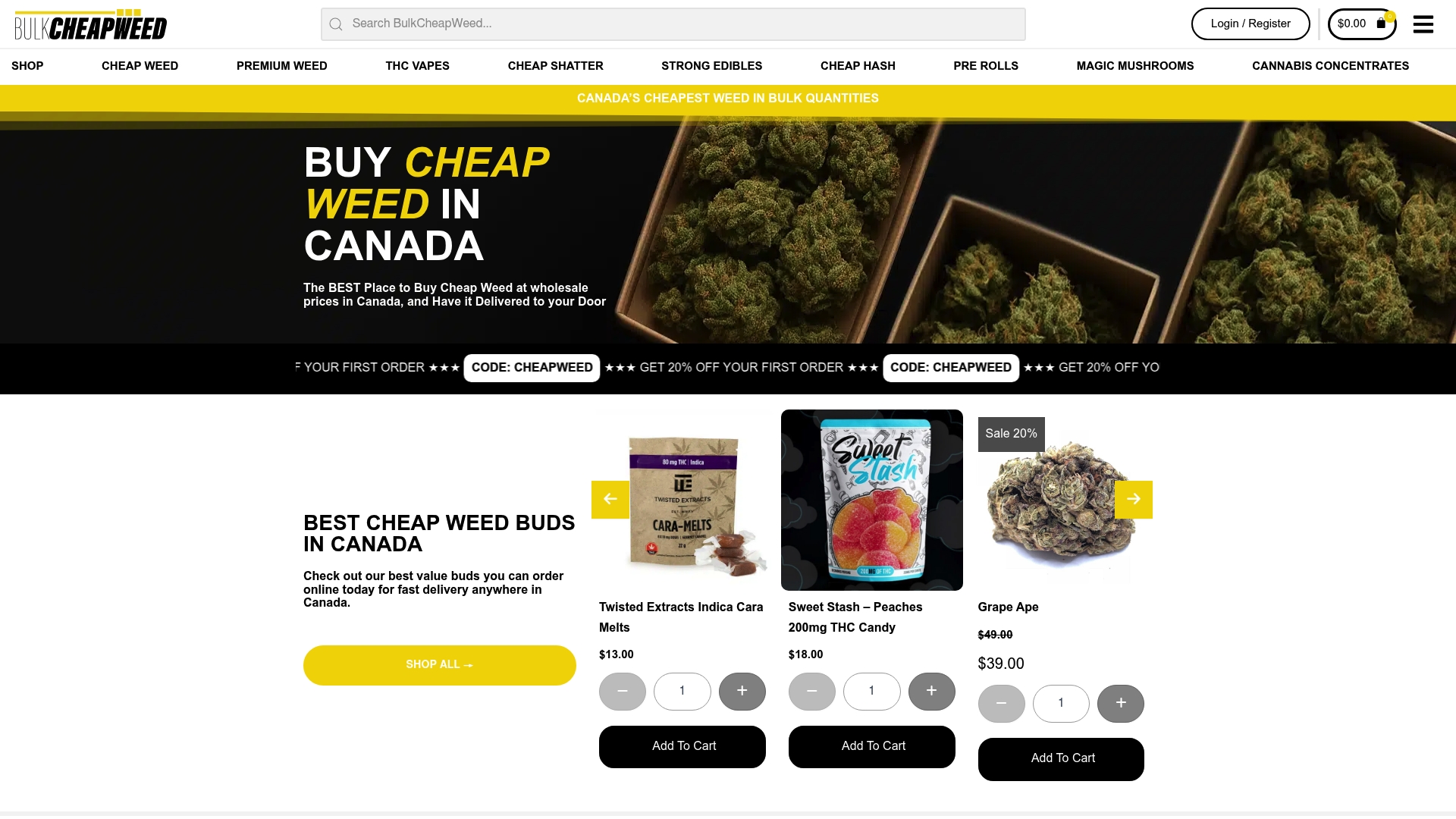
Start with the full catalogue on our homepage, or go straight to a category: shatter, concentrates or edibles. If concentrates are new to you, our guide to lab-tested cannabis concentrates and COA checks explains what to look for before ordering.
How to talk about weed origin without getting fooled
A few habits make you harder to mislead, whatever the label says:
- Treat origin claims as marketing until proven otherwise. “BC bud” is a reputation. Ask what the package, the stamp and the lab report say.
- Read THC and CBD off the package. Those are the regulated figures. Words like “premium” or “top shelf” are not.
- Match the batch. The lot number on your package should match the lab certificate, not just the brand.
- Match the effect to the type and terpenes. Indica, sativa and hybrid are rough guides, and terpenes add detail.
- Start low if you are new. Potency varies enormously, and the historical 15% to 30% range for BC bud is a reminder of how far apart two products with the same name can be.
- Walk away from sellers that fail the legality signs. No physical location, no age-gating, or cryptocurrency-only payment are reasons to stop.
FAQ
What does BC bud mean?
It means cannabis flower from British Columbia. The term began with sinsemilla grown in the province and later became a catch-all for high-grade Canadian marijuana, according to the U.S. Department of Justice. Today it works mostly as a reputation for quality, not a technical category.
What does BC mean in slang?
In most slang uses, BC stands for British Columbia, and in cannabis talk it points to the province’s weed. In other contexts “BC” can mean “before Christ,” but a search about bud is almost always about the province.
Is BC bud a strain?
No. It describes where the cannabis was grown, not its genetics. Merry Jane notes it refers to strains grown in British Columbia rather than to one particular strain. To pick a strain, look at its type (indica, sativa or hybrid), terpene profile and THC and CBD levels.
Is BC bud always strong?
Not necessarily. Historic estimates put BC bud’s THC between 15% and 30%, which is a very wide gap. Because “BC bud” is not a regulated grade, use the potency printed on the package and the batch’s lab result to know what you are getting.
How can I tell if the cannabis I buy online is legal?
Buy from a retailer authorized by your province or territory, and check the package for an excise stamp, health warning, the THC symbol and child-resistant packaging. B.C. also warns about sites with no physical location, no age-gating, cryptocurrency payment or cross-border shipping.
Sources
- Marijuana – Washington Drug Threat Assessment (U.S. Department of Justice)
- The untold history of B.C. cannabis (Georgia Straight)
- BC Bud’s Long Road to Legalization (BC Magazine)
- Legalization leaves BC bud behind for now (The Globe and Mail)
- What Do You Call Your Weed? (Merry Jane)
- What Canada’s Cannabis Shelves Teach About Grading (Tekedia)
- Reduce your risk: Choose legal cannabis (Health Canada)
- Buy legal cannabis (Province of British Columbia)
- Safer Cannabis Use: Marijuana, hash, hash oil (Here to Help)
- What’s in your weed? (CBC News)