

Buying weed in bulk usually saves Canadian consumers real money, often a significant discount off single-gram prices once you clear a quarter-pound threshold but only if you already consume enough to use the product before it degrades. The math favors bulk buyers who stock a household supply, respect Health Canada’s possession guidance, and buy from licensed sources rather than unregulated sellers. It does not favor occasional users who’ll let half of it go stale in a drawer.
TL;DR:
- Buying in bulk offers the best value only if you consume enough to prevent product degradation before it expires.
- Bulk discounts become meaningful at quarter pound or half pound thresholds, especially when using mix-and-match options to maximize savings.
- Effective per-gram cost calculations should include shipping, taxes, and other hidden fees, not just the sticker price.
- The legal storage of bulk cannabis depends on provincial rules, and a household stockpile is legal if stored properly at home.
- Flower provides the highest bulk savings, while concentrates and edibles offer better value measured per milligram of active ingredient.
Table of Contents
- Understanding Weed Bulk Pricing: Weight Tiers and Legal Limits
- How Do Bulk Discount Tiers and Wholesale Accounts Work?
- How to Calculate Per-Gram Value and True Savings
- Which Bulk Quantity Fits Your Consumption Pattern?
- Which Product Categories Save the Most in Bulk?
- Storage and Hidden Costs That Erode Bulk Savings
- How to Vet a Licensed Canadian Bulk Seller
- Timing and Strategy: When to Buy Bulk vs. Wait
- Why Bulk Cheap Weed Built Its Pricing Around Transparent Tiers
- Get the Best Per-Gram Value on Your Next Bulk Order
- Sources
- FAQ
Understanding Weed Bulk Pricing: Weight Tiers and Legal Limits
Retail menus throw around terms that mean nothing until you convert them to grams. A quarter pound (often shortened to “QP”) is 113.4 grams. A half pound is 226.8 grams. A full pound is 453.6 grams. An ounce, the unit most Canadian retailers use as their baseline, is 28.35 grams. Every bulk discount tier is really just a grams-per-dollar comparison wearing a fancier name, and once you strip away the label, comparing a QP deal to a per-ounce price becomes a five-second calculation.
The legal side matters just as much as the math. Under federal cannabis law, adults can legally possess up to 30 grams of dried cannabis (or its equivalent) in public at any one time. That figure covers what you can carry outside your home, not what you can keep inside it. Health Canada’s guidance on licensed producers and cannabis regulations clarifies that provinces set their own rules for in-home storage limits, and most provincial frameworks allow considerably more for personal use than the 30 gram public limit implies.
That distinction shapes how you should think about a bulk order. A pound of flower sitting in your home is a storage question, not a possession violation, as long as your province’s rules allow it and you’re not walking around town with it. Practically, this means:
- Bulk purchases work as a household stockpile, kept sealed and stored at home, not as something you split into public-carry amounts day to day.
- Splitting a large order among household members who each keep their own legal allotment is the safer way to interpret “bulk” if your home limit is tight.
- Public possession limits reset per outing, but your at-home stock is what regulators actually track when they talk about legal cannabis storage.
Get the units and the limits straight first. Everything downstream, including whether a “bulk discount” is actually a good deal, depends on knowing what a gram costs you and whether you’re legally allowed to hold that much where you live.
How Do Bulk Discount Tiers and Wholesale Accounts Work?
Tiered pricing on a cannabis menu almost always works one of two ways: automatic price breaks or coupon-triggered discounts. Automatic tiers are the cleaner system. Once your cart hits a set weight threshold, the platform recalculates every unit price on the page, no code required. Coupon-based tiers require you to apply a specific promo string at checkout, and if you forget, you pay full retail without any warning. Wholesale platforms like Ignite Wholesale’s bulk pricing pages use the automatic model, where reaching an account tier makes discounted prices populate directly on product pages.
Most bulk menus also set a minimum order quantity, or MOQ, before any tier pricing kicks in at all. That MOQ is often the entry point to the lowest tier, commonly a quarter pound or half pound depending on the seller. Above the MOQ, sellers typically let you combine different strains to reach the discount threshold rather than forcing you to buy multiples of a single strain. This is called mix and match, and it’s one of the most underused levers in bulk buying, since it lets a variety-seeking buyer hit a QP discount without committing to 113 grams of one cultivar.
Here’s the general sequence most Canadian bulk menus follow:
- Browse the menu and note the per-gram price at each posted weight break (quarter pound, half pound, pound).
- Build a cart using mix-and-match rules to hit the lowest qualifying MOQ, blending strains if the menu allows it.
- Watch for the discount to apply automatically at checkout, or confirm a promo code applies if the tier is coupon-based.
- Check for non-price perks tied to the tier, since some sellers add priority processing or account credit at higher volumes rather than a straight price cut.
Sample bulk menus, like the tier tables published by Culture Canna’s bulk menu, show how these MOQ and mix-and-match structures typically get presented, though exact numbers vary seller to seller.
Pro Tip: Screenshot the per-gram price at each tier before you build your cart. Some menus display the discounted rate only after you hit the minimum, which makes it hard to compare tiers side by side once you’re mid-checkout.
How to Calculate Per-Gram Value and True Savings
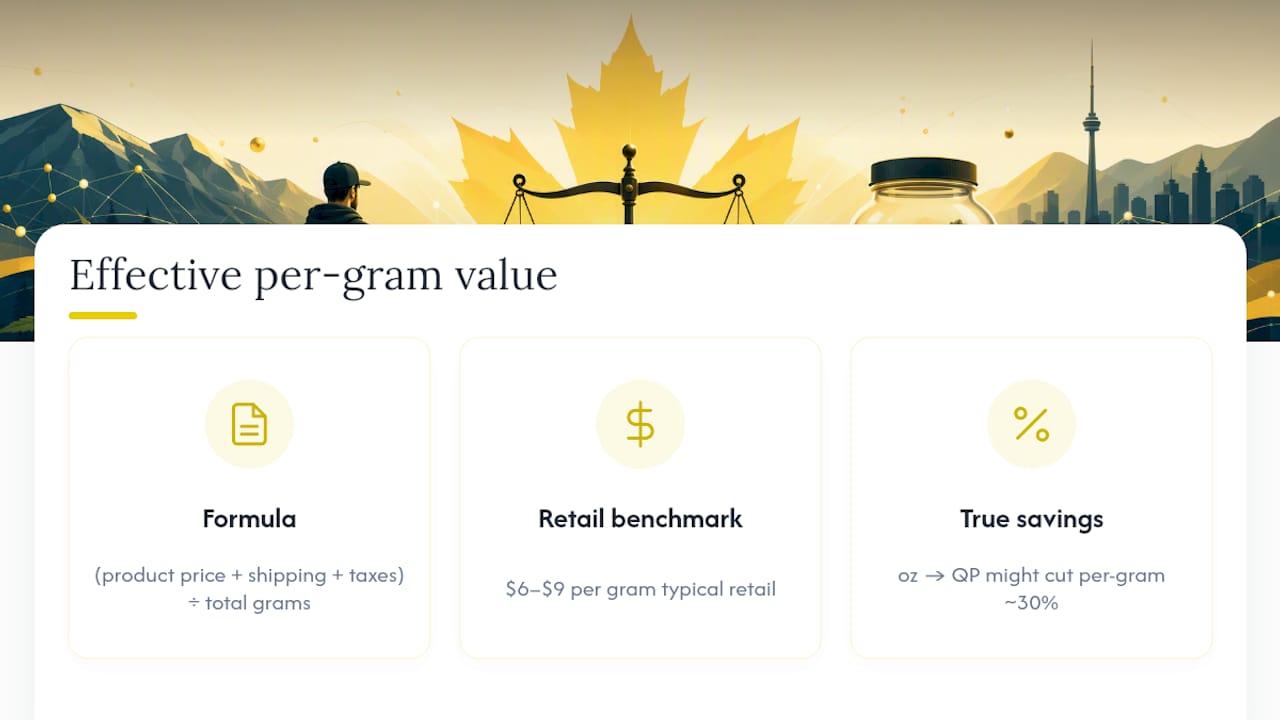
The formula is simple: effective price per gram = (product price + shipping + taxes) ÷ total grams. Compare that number against the standard single-gram or single-ounce retail price to get your real discount percentage, not the advertised one. Advertised bulk discounts describe the sticker price drop; your effective discount has to account for every dollar leaving your account, including provincial excise components baked into legal cannabis pricing.
Here’s how that plays out across three common Canadian bulk tiers, using representative retail spreads rather than any single seller’s live pricing:
Line these up against a standard single-ounce retail price, which frequently lands between $6 and $9 per gram at non-bulk rates, and the QP tier already represents a meaningful drop. Market indexes like Cannabis Benchmarks’ spot price reports track how pound-level pricing shifts over time in the U.S. wholesale market, and the same volatility logic applies domestically: prices move, and locking in a bulk rate during a dip beats buying at the peak.
The catch is marginal savings shrink as you move up tiers. Jumping from an ounce to a QP might cut your per-gram cost by 30%. Jumping from a half pound to a full pound saves less still, unless a seller’s steepest discount sits specifically at the pound threshold. Before moving up a tier, ask whether the extra dollars saved per gram actually outweigh the extra weeks it’ll take you to use that much product.
Which Bulk Quantity Fits Your Consumption Pattern?
The right tier depends on how much you actually smoke or consume in a month, not on how good the discount looks on the menu. Buying past your consumption rate just trades savings for spoilage risk.
- Occasional solo users (a few grams a week): stick to ounces or a single QP at most. A half pound sitting around for four months loses potency before you finish it.
- Regular solo users (roughly 10 to 15 grams a week): a QP is usually the sweet spot, giving a meaningful discount while lasting about two to three months.
- Two-person households with combined regular use: a half pound often clears in two to three months between both people, hitting a stronger per-gram rate without excess.
- Social buyers and larger households sharing across several regular users: a full pound can make sense if turnover is fast enough that the batch is gone in six to eight weeks.
Past the pound tier, diminishing returns usually set in. Most Canadian bulk sellers reserve their steepest percentage jump for the pound threshold and flatten discounts beyond it, so buying two pounds instead of one rarely improves your per-gram cost by much. At that point you’re just carrying more freshness risk for a marginal reward.
Which Product Categories Save the Most in Bulk?
Flower delivers the deepest bulk discounts of any cannabis category, and it’s not close. Wholesale flower pricing scales cleanly with weight because the cost structure behind it, cultivation and trimming labor, spreads across more grams as order size grows. Category breakdowns like LeafLink’s Wholesale Cannabis Pricing Guide show flower consistently carrying the widest wholesale-to-retail spread of any product type in the U.S. market, a pattern that generally holds in Canadian bulk pricing too.
Concentrates and edibles work differently because you’re not really buying grams, you’re buying milligrams of active THC or CBD. A gram of shatter or live resin holds far more potency per gram than flower, so bulk savings there should be measured per milligram of THC, not per gram of product. The same logic applies to edible pricing, where cost efficiency is better tracked in cents per milligram than in package count.
A few rules of thumb worth following:
- Buy flower in bulk aggressively; it’s where the tier math rewards you the most.
- Buy pre-rolls in bulk only when pack-count tiers (5, 25, 50) align with how fast you’ll actually use them, since pre-rolls dry out faster than sealed flower.
- Buy edibles in smaller packaging unless you have long-term stable storage, since shelf life and dosing consistency matter more than unit price for most edible buyers.
- Treat vape cartridges and concentrates as a potency purchase first, checking cost-per-mg before comparing them against flower’s cost-per-gram.
Storage and Hidden Costs That Erode Bulk Savings
A bulk discount is only real savings if the product stays good long enough for you to use it. Improper storage is the fastest way to turn a great per-gram deal into wasted money. Keep bulk flower in sealed, airtight glass jars, away from direct light, at a stable cool temperature, and use two-way humidity control packs to hold moisture in the 58% to 62% range. Research on plant material storage and degradation confirms that controlled humidity and light exposure materially slow cannabinoid and terpene breakdown, which is exactly what preserves the value you paid for.

Beyond storage, a few line items quietly eat into bulk savings if you don’t fold them into your per-gram math: shipping costs on larger orders, provincial and federal excise taxes already embedded in shelf pricing, and the cost of jars or humidity packs themselves. Amortize these across the total gram count rather than treating them as separate expenses, since a $15 shipping fee on a QP order adds roughly $0.13 per gram, a number that shrinks fast as order size grows.
Pro Tip: If your flower starts smelling faintly like hay or cardboard instead of its original terpene profile, that’s your early warning sign of degradation, well before visible mold or brittleness shows up.
How to Vet a Licensed Canadian Bulk Seller
Buying bulk only pays off if the product is real and the seller is legitimate. Start by confirming licensing status through Health Canada’s resources on licensed producers, which lists the regulatory framework legal sellers operate under. Public Safety Canada’s guidance on illegal online sales is blunt about the risk of buying from unlicensed platforms, including no quality guarantees and no recourse if something goes wrong.
Certificates of analysis, or COAs, are your next checkpoint. A legitimate COA shows THC and CBD percentages tested by a third-party lab, along with screening for contaminants like pesticides, heavy metals, and microbial growth. If a bulk seller can’t produce one for the batch you’re buying, treat that as a hard stop, not a minor gap.
Before placing a bulk order, check these items on the seller’s terms page:
- Minimum order quantities and whether mix-and-match is allowed across strains or product types.
- Shipping timelines, since bulk orders sometimes ship separately from single-item orders.
- Refund and return policy in case a batch arrives damaged or doesn’t match its listed COA.
- Whether lab results are batch-specific or a generic average, since batch-specific COAs are far more trustworthy.
Quality descriptors on flower listings, like trichome density and terpene visibility, are worth understanding too. A guide to recognizing CBD flower quality breaks down the visual and aromatic cues that separate genuinely high-grade flower from bulk filler, a useful reference even outside the CBD category.
Timing and Strategy: When to Buy Bulk vs. Wait
Bulk savings compound when you combine tier discounts with smart timing. A few tactics consistently beat buying whenever the mood strikes:
- Track flash sales against your tier math. A 15% flash discount on a half-pound order can beat a “permanent” full-pound tier price if the pound tier’s marginal savings were thin to begin with.
- Use mix-and-match to hit a threshold without overcommitting to one strain. This is the single easiest way to reach a QP or half-pound discount while still getting variety.
- Consider recurring or subscription-style orders if a seller offers them. Locking in a repeat bulk order at a set cadence smooths out price volatility and often unlocks loyalty-based perks beyond the base tier discount.
- Pool legally within your household rather than pooling across separate households. Two adults under one roof splitting a half pound stays inside most provincial storage allowances; splitting an order across unrelated buyers to dodge possession limits does not, and creates real legal exposure.
- Run the per-gram formula from earlier on every deal before buying. A weekly flash sale on ounces sometimes beats a stale QP price that hasn’t moved in months, especially with Cannabis Benchmarks data showing how much spot pricing can swing.
Keep a simple record of what you paid per gram on your last two or three orders. That history turns “is this a good deal” from a guess into a five-second comparison against your own baseline, which is a far more reliable indicator than whatever discount percentage the seller prints on the page.
Why Bulk Cheap Weed Built Its Pricing Around Transparent Tiers
Most of the frustration Canadian buyers run into with bulk weed comes down to hidden math: menus that don’t show per-gram pricing, coupon tiers that require guesswork, or MOQs buried in a terms page. Bulk Cheap Weed’s bulk shop lists tier pricing and mix-and-match rules directly on the product pages, so the calculation method covered above can be applied without digging for hidden fees. Combined with Canada-wide discreet shipping, a satisfaction guarantee, and an affiliate program for repeat community buyers, the model is built around the same transparency this guide asks readers to demand from any seller.
— Supherbs
Get the Best Per-Gram Value on Your Next Bulk Order
Some bulk cannabis sellers provide transparent tier pricing shown on product pages, mix-and-match flexibility across strains, and discreet Canada-wide shipping to make bulk orders easier for buyers.
Before you commit to a tier, run the numbers yourself using the formula above, and confirm the batch you’re buying has a current COA on file. Here’s how to test any deal before checkout:
- Calculate the effective per-gram price including shipping and taxes, not just the sticker discount.
- Check that the listing includes lab-tested results and matches the batch you’re actually receiving.
- Start with a smaller bulk tier, like a sample pack of infused pre-rolls, if you’re testing a new strain before committing to a full quarter pound.
| Quick test | What to check |
|---|---|
| Real discount | Effective price per gram vs. standard retail per gram |
| Quality proof | Current, batch-specific COA on file |
| Fit for your use | MOQ and mix-and-match rules match your consumption pace |
Browse the full bulk product lineup to compare tiers directly, or check order tracking once your first bulk shipment is on the way.
Sources
This guide draws on federal cannabis regulation guidance from Health Canada, which governs licensing and consumer protections for legal Canadian sellers, and Public Safety Canada’s warnings about unlicensed online sales. Market-price context comes from LeafLink’s wholesale pricing guide and Cannabis Benchmarks’ spot price reports, both U.S. market data used here only to illustrate how wholesale and pound-level pricing trends behave, not as Canadian pricing itself.
- Health Canada – Licensed producers and cannabis regulations
- Reports Archive – Cannabis Benchmarks
- Public Safety Canada – Illegal online sales of cannabis
FAQ
What are Tier 1 and Tier 2 weed products?
“Tier 1” and “Tier 2” typically refer to a retailer’s own internal grading of flower quality and price point, with Tier 1 usually meaning premium, higher-cost flower and Tier 2 meaning mid-grade, budget-friendly flower. These labels aren’t standardized across the industry, so always check a seller’s specific grading criteria and COA rather than assuming the tier name guarantees a certain potency or quality level.
Does Canada have the cheapest weed?
Canada’s legal cannabis prices are competitive but not universally the lowest, since pricing depends heavily on province, product category, and whether you’re buying retail or bulk. Bulk discount tiers are one of the more reliable ways Canadian buyers actually lower their effective per-gram cost, often by a meaningful percentage compared to single-gram retail pricing.
How much weed can you legally have in Canada in your house?
Federal law sets the public possession limit at 30 grams of dried cannabis or its equivalent, but at-home storage limits are typically set provincially and are usually higher than the public limit. Check Health Canada’s guidance and your specific province’s cannabis regulations before assuming a bulk order fits your legal storage allowance.
Which online dispensary in Canada is considered the best for bulk orders?
The best choice depends on transparent tier pricing, mix-and-match flexibility, and verified lab results rather than brand reputation alone. Bulk Cheap Weed structures its bulk shop around exactly those criteria, with tier pricing and mix-and-match rules shown directly on product pages so buyers can calculate real savings before checkout.