

Yes, you can get discreet shipping in Canada, but billing records still exist no matter what a retailer promises. Licensed sellers can send anonymous outer packaging and offer delivery options like Canada Post FlexDelivery, yet your bank, payment processor, and the Office of the Privacy Commissioner of Canada all confirm that transaction data is retained somewhere. Real privacy means minimizing exposure, not eliminating a paper trail.
TL;DR:
- Discreet packaging involves anonymous outer mailers and odor-blocking inner containers, but legal packaging laws require product labels and health warnings inside the parcel.
- Payment methods like credit cards or Interac e-transfers leave digital records, so a vague billing descriptor only hides the purchase from your bank statement, not the underlying data.
- Selecting options like FlexDelivery, hold-for-pickup, or parcel lockers reduces the chance someone at your address sees the delivery, but ID verification may be required for pickup.
- Verifying licensed retailers’ compliance, transparency about packaging, and clear privacy policies help ensure the purchase remains private and legitimate.
- Retailers like Bulk Cheap Weed use anonymous outer packaging and provide customer support to uphold privacy, aligning with Canadian legal and privacy regulations.
Table of Contents
- How discreet shipping and packaging actually work in Canada
- What your payment method reveals about your order
- Delivery and pickup choices that reduce how much others see
- Verifying a retailer before you hand over payment details
- Legal rules that shape what can and cannot be hidden
- Spotting sellers and payment setups you should avoid
- Step-by-step checklist for a more private checkout
- Why discreet shipping matters more than it looks
- How Bulk Cheap Weed handles discreet shipping and privacy
- Sources
- FAQ
How discreet shipping and packaging actually work in Canada
Discreet shipping is really two layers working together. The outer mailer carries no branding, no cannabis leaf, and no retailer name that gives away the contents to a roommate, a neighbor, or a curious delivery driver. Inside that plain box or envelope sits the product’s actual packaging, which by law has to carry the standardized cannabis symbol, health warnings, and other mandatory details, since that inner layer is what regulators inspect, not the mailer.
Retailers commonly use vacuum-sealed bags or small odor-blocking plastic containers to stop smell from reaching the outer packaging, a practice Health Canada’s packaging guidance recognizes as standard for cannabis shipments. Several people handle a parcel between checkout and your doorstep, and each one sees only part of the picture.
- Fulfillment staff see the order details and pack the product into labeled inner containers.
- Carrier sorting facilities see a sealed, anonymous parcel with a shipping label and nothing else.
- The delivery driver sees a generic box, not what’s inside it.
Handling times vary with carrier volume, weather, and how far the destination is from the fulfillment center, so a plain-looking package moving through the postal system rarely raises questions. For a closer look at what these layers look like in practice, what real discreet weed packaging actually looks like walks through examples of both inner and outer packaging.
Pro Tip: Ask a retailer whether their outer packaging includes any text, logo, or shape that could hint at cannabis before you order, since some “discreet” boxes are only discreet in name.

What your payment method reveals about your order
Every payment method leaves a trail somewhere, and the differences come down to who holds the record and how visible it is on your own statement.
- Credit and debit cards route through a payment processor and your bank, both of which log the merchant name, amount, and date regardless of how vague the statement descriptor looks.
- Interac e-transfer shows the recipient’s name or business alias on your bank statement, which is why many dispensaries favor it: the transfer itself carries less merchant metadata than a card transaction.
- Digital wallets and cryptocurrency feel anonymous but are traceable through wallet addresses and exchange records, so the privacy is more perceived than absolute.
- Cash avoids most digital trails entirely but isn’t practical for an online order placed from home.
A vague or generic descriptor on your card statement does not erase the underlying record. The Privacy Commissioner’s guidance on digital payments notes that online payments can also transmit IP address, device information, and browsing history to merchants and processors for fraud management, which means the data footprint of an online purchase extends beyond the visible line item on your statement. A “discreet” billing label changes what you see, not what your bank or processor keeps on file. For a practical breakdown of e-transfer risks and safeguards, avoiding scams when paying by Interac e-transfer is worth reading before checkout.
Delivery and pickup choices that reduce how much others see
Where your order lands matters as much as how it’s wrapped. A few delivery choices genuinely cut down on who sees a parcel arrive at your address.
- Register for FlexDelivery. This free Canada Post service lets you receive parcels at a chosen post office instead of your home, and pickup requires government-issued photo ID matching the FlexDelivery address you registered.
- Use hold-for-pickup at a post office. Canada Post’s flexible delivery options explain how a delivery notice card triggers pickup, with ID checked against the name on the parcel.
- Consider a parcel locker or PO box where available, since both keep the delivery separate from your front door.
- Turn off shared notifications. If your household shares a Canada Post account or email, tracking alerts can tip off anyone with access, so use a personal login.
Local courier services vary widely: some offer no-signature drop-off that beats postal pickup for convenience, while others require the same ID verification as FlexDelivery, so check before assuming equivalent privacy. Using FlexDelivery shifts the privacy question from “who sees the box on my porch” to “who can access my ID and pickup record,” which is a trade worth understanding rather than assuming away.
Pro Tip: Register your FlexDelivery address using the exact name on your government ID, since a mismatch is the most common reason pickups get delayed at the counter.

Verifying a retailer before you hand over payment details
Not every site that advertises “discreet” shipping backs it up, so a few checks before checkout go a long way.
- Confirm licensing signals. Legitimate sellers reference compliance with Health Canada packaging rules and CRA excise stamp requirements rather than staying vague about sourcing.
- Read the actual privacy policy, not just a badge. A meaningful policy states what data is collected, why, and how long it’s kept, in line with what PIPEDA requires of private-sector retailers.
- Ask to see packaging photos. A retailer confident in its process will show the plain outer mailer and tamper-evident inner packaging before you order.
- Check return-address practices. Some retailers use a generic business name on the return address rather than one that references cannabis at all, a detail covered in does a discreet return address actually protect your order.
- Ask customer service directly whether they store payment details, what the billing descriptor will say, and whether receipts are sent by email or only through an account portal.
A retailer that dodges these questions or gets defensive about them is telling you something.
Legal rules that shape what can and cannot be hidden
Canada Post, Health Canada, and the CRA each set rules that determine where discretion ends and disclosure begins. Canada Post’s guidance for cannabis shipments calls for sealed, odor-blocked, tamper-evident parcels with anonymous outer packaging so contents can’t be identified without opening the box.
- Health Canada requires the standardized cannabis symbol, health warnings, and licence-holder information on the product’s immediate packaging, not the shipping box.
- The CRA’s excise stamp regime requires duty-paid cannabis to carry a stamp indicating it entered the legal market; its absence is a signal the product may not be legitimate.
- Canada Post’s packaging standard recommends vacuum-sealed bags or small odor-proof containers inside a plain, unmarked outer parcel.
The rules split neatly in two: the outer package stays anonymous, while the product inside stays fully labeled. That’s the legal balance between your privacy and the regulator’s need to track a legal cannabis market.
Spotting sellers and payment setups you should avoid
Some warning signs point straight to unlicensed or risky operations, and they’re worth knowing before you send any payment.
- Unusual e-transfer patterns, including requests to split payments across multiple transfers or send funds to a personal name rather than a business. FINTRAC’s analysis of illicit cannabis activity found frequent use of email money transfers, cash deposits, cheques, and virtual currencies among suspected illicit operators, with remittance notes sometimes containing cannabis-related jargon that should never appear in a legitimate transaction memo.
- No licence information anywhere on the site, or vague answers when you ask about it directly.
- Evasive responses about packaging or data handling, especially when a seller won’t describe what the outer mailer looks like.
- Extreme privacy promises paired with nonstandard payment requests, such as insisting on crypto-only payment with no alternative, which is a pattern worth treating with caution rather than reassurance.
If something feels off, you can report suspected illicit sellers through provincial cannabis regulators, and sticking to licensed retailers with clear packaging and payment practices remains the safer path. The checklist in 4 quick checks to buy weed online safely in Canada covers this ground in more detail.
Step-by-step checklist for a more private checkout
Running through these steps in order gives you the best realistic privacy outcome without slowing checkout down much.
- Verify the retailer’s licence and privacy policy before typing in any payment information.
- Choose FlexDelivery or hold-for-pickup instead of home delivery when the option is available.
- Use the exact name on your government ID when registering for pickup, since a mismatch causes delays.
- Ask about a discreet billing descriptor if the retailer offers one, understanding it changes what appears on your statement, not what’s stored internally.
- Avoid saving payment details to an account, and use a dedicated email address for order confirmations.
- Opt out of marketing emails and loyalty programs at checkout so your purchase history isn’t tied to ongoing communications.
Pro Tip: A dedicated email address used only for cannabis orders keeps receipts out of your main inbox and off shared devices.
Why discreet shipping matters more than it looks
Privacy in cannabis purchases isn’t about hiding wrongdoing, since the product is legal for adults across Canada. It’s about the ordinary discomfort of a delivery driver, a nosy neighbor, or a family member seeing something you’d rather keep to yourself. That’s a reasonable thing to want, and it’s why packaging and delivery choices matter as much as price.
What’s underappreciated is how much of the real privacy work happens before checkout, in choosing a licensed retailer with a real privacy policy, rather than after, in hoping a vague billing descriptor covers for it. Some retailers build their shipping process around anonymous outer packaging and a customer satisfaction guarantee, treating discretion as part of the product experience rather than an afterthought.
— Supherbs
How Bulk Cheap Weed handles discreet shipping and privacy
This retailer ships orders across Canada with anonymous outer packaging and fast turnaround, backed by a customer satisfaction guarantee that stands behind every order. That approach lines up directly with the checklist above.
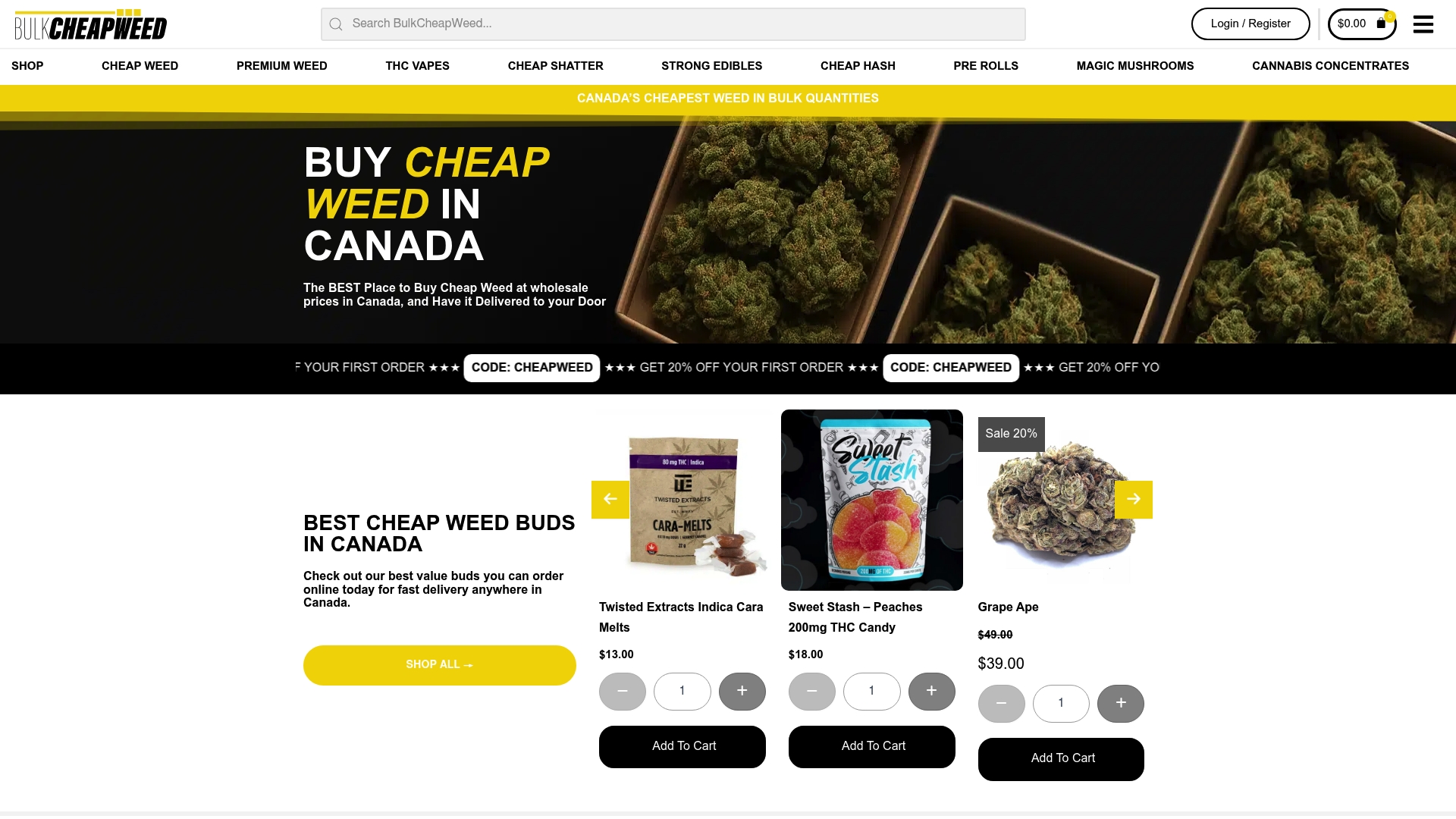
- Anonymous outer mailers on every shipment, keeping product details away from prying eyes at the door.
- Bulk pricing across flower, shatter, hash, edibles, vape pens, and mushrooms, so budget-conscious buyers aren’t paying more for privacy.
- Direct customer service for questions about shipping, receipts, or order details before you commit to a purchase.
Browse the full catalogue at Bulk Cheap Weed and place an order with the packaging and delivery practices covered in this guide already built in.
Sources
- Office of the Privacy Commissioner of Canada — guidance on collecting personal information
- Canada Post — FlexDelivery
- FINTRAC analysis of financial intelligence related to illicit cannabis
- Health Canada — packaging and labelling guide for cannabis products
FAQ
What is $40 worth of weed called?
There’s no official or standardized term for a typical amount of cannabis, since naming varies by retailer and region rather than following a fixed rule. Common slang terms exist informally across Canada, but pricing and quantity depend on the specific product and seller.
How much does it cost to get your CannSell?
CannSell certification costs and requirements are set by Ontario’s cannabis retail training program and vary depending on the course provider. Since pricing isn’t part of this article’s sourced data, check directly with a CannSell-approved training provider for current costs.
Is it illegal to order weed online in Canada?
Ordering cannabis online is legal in Canada when you buy from a licensed retailer authorized to sell in your province. Buying from an unlicensed seller carries legal risk and offers none of the packaging or labelling protections that licensed retailers must follow under Health Canada’s rules.
Do they check for weed at the Canadian border?
Cannabis remains illegal to bring across the Canadian border in either direction, regardless of its legal status within Canada, and border officers can inspect packages and parcels. This is a separate question from domestic shipping between licensed retailers and consumers within Canada.
Does a discreet billing descriptor actually hide my purchase?
A discreet descriptor changes what appears on your statement line, but it doesn’t remove the transaction record your bank or payment processor keeps on file. Real privacy comes from choosing a retailer with a clear privacy policy and minimal data retention, not from the wording on a receipt.