

Start with 2.5 mg of THC in an edible, taken 60 to 90 minutes before bedtime, and give yourself at least a week before judging results. Most adults find that a low dose in the 2.5 to 5 mg range nudges sleep onset without wrecking the next morning. Going above 10 mg tends to backfire, causing grogginess or restless sleep instead of deeper rest. Never redose within two hours, since edibles take time to kick in.
TL;DR:
- Starting with 2.5 mg of THC is safest, as doses above 10 mg tend to disrupt sleep architecture and cause grogginess.
- Edibles typically take 30 to 90 minutes to onset and last 4 to 8 hours, requiring careful timing before sleep.
- Tolerance, body weight, age, and last meal significantly influence each individual’s optimal dose, emphasizing gradual titration.
- Avoid redosing within two hours to prevent overconsumption, and keep a detailed sleep and dose log for effective adjustment.
- Lab-tested gummies provide the most accurate and consistent dosing, with tinctures offering finer control for precise titration.
Table of Contents
- What Is the Right Edible Dosage for Sleep?
- Why Do Edibles Take Longer to Work Than Smoking?
- What Personal Factors Change Your Ideal Dose?
- What Are the Warning Signs of Too Much THC?
- How Do You Find Your Ideal Dose Safely?
- Should You Combine THC With Other Sleep Supplements?
- Gummies, Tinctures, or Baked Goods: Which Is Easiest to Dose?
- Is Using THC Edibles for Sleep Legal?
- Why Microdosing Beats Chasing a “Knockout” Dose
- Where to Find Reliable Low-Dose Edibles
- Sources
- FAQ
What Is the Right Edible Dosage for Sleep?
The clinical starting dose most practitioners point to is 2.5 mg of THC. That figure comes directly from Health Canada’s guidance on cannabis for medical purposes, which treats 2.5 mg as a conservative entry point rather than a target dose. The idea is to nudge your nervous system toward sleep, not knock yourself out.
Below is a quick reference for how different dose bands tend to behave, based on clinical trends. These are general patterns, not guarantees. Your weight, tolerance, and metabolism all shift where you land.
| Dose Band | Typical Effect | Sleep Impact | Risk Level |
|---|---|---|---|
| 1–2.5 mg | Very low, subtle calming | Mild help with falling asleep | Minimal |
| 2.5–5 mg | Low, the clinical sweet spot | Shorter sleep latency, fewer awakenings | Low |
| 5–10 mg | Moderate | Stronger sedation, some report grogginess | Moderate |
| 10 mg+ | High | Increased risk of disrupted sleep architecture | Elevated, not recommended for sleep |
That last row matters more than it looks. Clinical guidance from Health Canada notes that doses above 10 to 15 mg are more likely to suppress REM sleep and leave you foggy the next day. That’s the opposite of what you’re chasing.
Here’s how to use the chart depending on where you’re starting from:
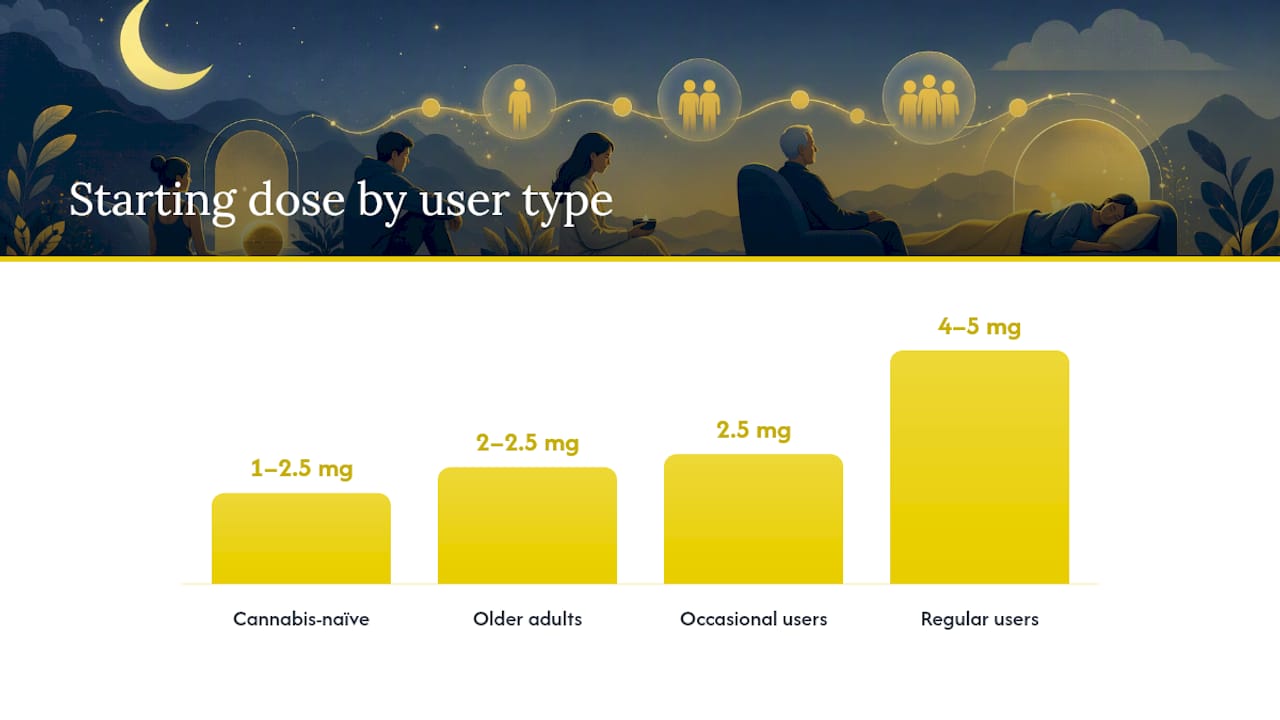
- First-timer or cannabis-naïve: Begin at 1 to 2.5 mg. You can always go up. You can’t take back an edible once it’s in your system.
- Occasional user with some tolerance: 2.5 to 5 mg is a reasonable starting range, based on how your body has responded to cannabis before.
- Regular user chasing sleep specifically: Even with tolerance built up for other effects, sleep response doesn’t always scale the same way. Start at the low end of your usual range.
- Anyone over 10 mg for sleep: Consider this a signal to scale back, not push forward. More isn’t better here.
A practical dosage calculator from JustKana backs this up from the consumer side, suggesting 1.5 to 3 mg for highly sensitive users and 2.5 to 5 mg for most beginners. The consistent message across clinical and consumer sources: start low, and treat “low” as genuinely low.
Why Do Edibles Take Longer to Work Than Smoking?
Edibles route THC through your digestive system and liver before it reaches your bloodstream. That process, called first-pass metabolism, changes both how strong the effect feels and how long it lasts. Pharmacology research on cannabinoid metabolism shows this conversion process can make oral THC hit harder and linger longer than inhaled cannabis at an equivalent dose.
That’s why the timing rules for edibles look nothing like the timing rules for a vape pen or flower.
- Onset typically runs 30 to 90 minutes, according to Health Canada’s risk-reduction guidance and detailed advice on how long do edibles last, which helps plan safe timing for use.
- Duration commonly stretches 4 to 8 hours.
- The practical takeaway: take your edible 60 to 90 minutes before you actually want to be asleep, as part of a wind-down routine rather than a last-minute fix.
A number worth remembering: 90 minutes. That’s the outer edge of typical onset. If you don’t feel anything at the 45-minute mark, resist the urge to take more. You’re not undosed, you’re just still waiting.
If you’re used to smoking and switching to edibles for sleep, the timing shift alone trips up a lot of people. A side-by-side breakdown of edibles versus smoking walks through why the same milligram amount can feel completely different depending on how you consume it, and it’s worth reading before your first edible night.
What Personal Factors Change Your Ideal Dose?
Two people can take the same 2.5 mg gummy and have completely different nights. Body weight plays a role, but it’s not the whole story. Metabolism, liver function, and how much fat is in your last meal all shift how quickly and intensely THC hits.
Tolerance matters more than most people expect:
- Cannabis-naïve users should treat 1 to 2.5 mg as a genuine ceiling for the first few tries, not a starting line to blow past.
- Occasional users (a few times a month) can usually start at 2.5 mg without much risk.
- Regular users may need the higher end of the low-dose range, 4 to 5 mg, but should still resist jumping straight to 10 mg just because tolerance feels high in other contexts.
Age changes the picture too. Older adults process cannabinoids more slowly and are more likely to be on other medications, so clinician guidance from The Well at Northwell recommends starting at 2 to 2.5 mg for older or cannabis-naïve patients specifically, with a physician in the loop if other prescriptions are involved.
Alcohol and sedative medications are the other wild card. Mixing either with THC edibles amplifies sedation unpredictably, and research from the National Institute on Drug Abuse flags this combination as a factor in edible-related overconsumption incidents.
Pro Tip: Keep a small notebook or phone note with your weight, what you ate that day, and how the dose felt. Your body composition shifts over months, and last year’s “perfect dose” might not be this year’s.
What Are the Warning Signs of Too Much THC?
The biphasic response is the single most misunderstood part of edible dosing. Low doses calm your system down. Higher doses can flip that effect entirely, increasing anxiety and actually disrupting sleep instead of helping it. Health Canada’s clinical guidance confirms this pattern: doses in the 1 to 5 mg range tend to support sleep, while doses above 10 to 15 mg trend toward the opposite result.
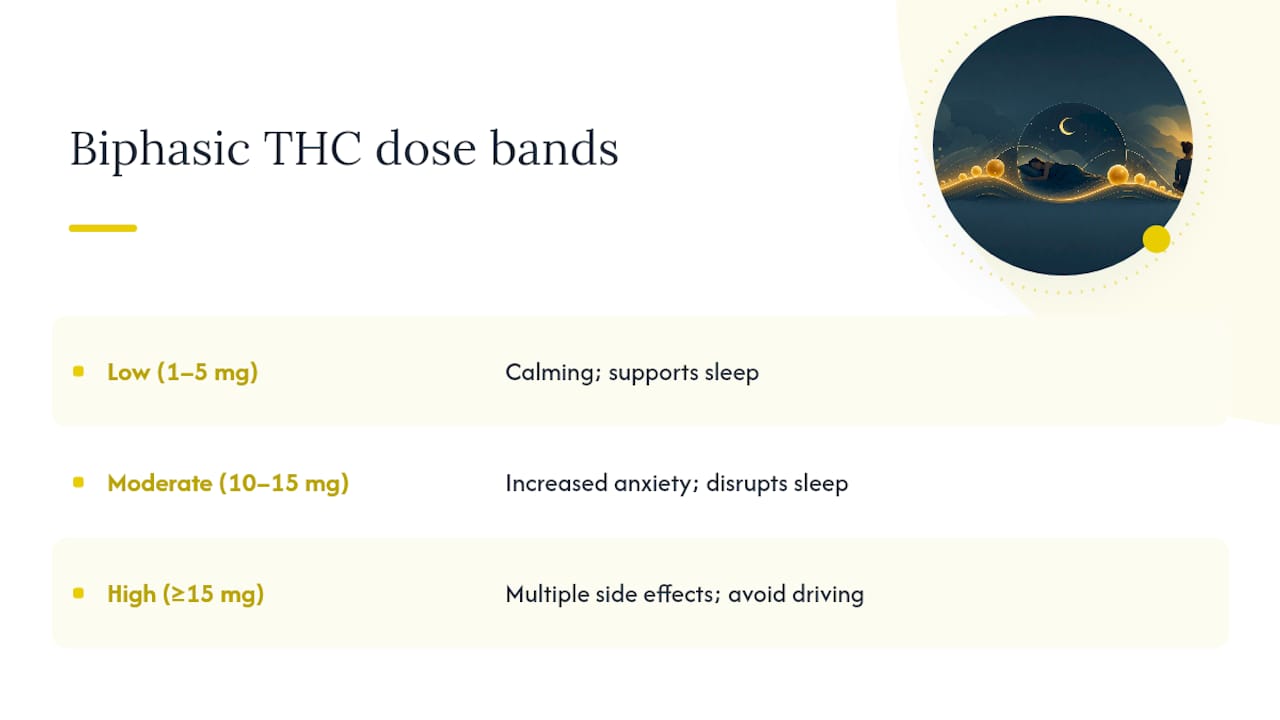
Here’s the number that surprises most first-time users: 10 to 15 mg. That’s a fraction of what many commercial gummies contain per piece, which is why splitting a single edible into quarters is common practice among experienced low-dose users.
Common side effects at higher doses can include dry mouth, mild dizziness, racing thoughts or anxiety, grogginess or brain fog the next morning, increased heart rate, and impaired coordination — all emphasizing the need to avoid driving if feeling off.
If you’ve taken too much, the response isn’t complicated: stay put, hydrate, and remind yourself the effects are temporary even though an hour can feel long. Seek emergency help if you experience chest pain, severe confusion, or vomiting that won’t stop. Panic during a strong edible reaction is common and usually passes; the risk-reduction resource from Health Canada is worth bookmarking before you ever need it, not after.
How Do You Find Your Ideal Dose Safely?
Finding your number is a process, not a guess. Here’s a straightforward protocol:
- Start at 2.5 mg. Take it 60 to 90 minutes before bed for 7 to 14 consecutive nights.
- Resist adjusting early. Sleep quality varies night to night for reasons that have nothing to do with dose. Two weeks gives you a real pattern instead of noise.
- If it’s not working, increase gradually. Move up by 0.5 to 2.5 mg at a time, never more.
- Hold each new dose for another 1 to 2 weeks before deciding whether to adjust again.
- Never redose within the same night. Two hours minimum, even if you feel like nothing happened yet.
A simple log makes this process far less guesswork-heavy. Track these fields each night:
- Date and dose taken
- Time the edible was consumed
- Estimated time to fall asleep (sleep latency)
- Number of awakenings during the night
- Perceived sleep quality (a 1 to 5 scale works fine)
- Next-day alertness and mood
Patterns usually show up within a week or two. If you’re not seeing them, a 21-day tolerance reset can sometimes recalibrate your response before you assume you need a higher dose.
Should You Combine THC With Other Sleep Supplements?
Pairing low-dose THC with CBN or CBD is common practice among people trying to keep their THC intake as low as possible. Research reviewing sleep-related supplements suggests these combinations can lower the effective THC dose needed while potentially reducing next-day grogginess, though the evidence base is still developing and results vary by person.
Melatonin and magnesium are the other common additions. That same supplement review notes melatonin shows effectiveness for circadian-related sleep issues at 0.5 to 5 mg, and magnesium trials report improvements in older adults at roughly 500 mg daily. Neither is a replacement for addressing why you’re not sleeping in the first place, but both have a more established evidence trail than most herbal blends on shelf labels.
- CBN or CBD stacked with 2.5 mg THC may allow an even lower THC dose.
- Melatonin works differently, targeting circadian rhythm rather than sedation directly.
- Anyone on prescription sleep medication or antidepressants should check with a clinician before stacking cannabinoids on top, since interaction risk is real and not well mapped for every drug combination.
If you’re deciding between cannabinoids rather than stacking them, a direct comparison of THC and CBD for sleep breaks down which one fits which kind of sleep problem.
Gummies, Tinctures, or Baked Goods: Which Is Easiest to Dose?
Not all edible formats are created equal when precision matters, and for sleep dosing, precision is the whole point.
Gummies are the most consistent option for most people. Commercial gummies are typically dosed in exact milligram amounts per piece, and many are scored so you can split them into quarters for true low-dose use. This makes them the easiest format for hitting a precise 2.5 mg target.
Tinctures offer even finer control, since a dropper lets you measure in smaller increments than a gummy allows. The tradeoff is that liquid tinctures held under the tongue can absorb partly through oral tissue, giving a faster, more sublingual-style onset rather than the classic delayed edible curve. That’s worth knowing if you’re timing a 90-minute wind-down and the effect shows up in 20 minutes instead.
Baked goods and homemade edibles are the least reliable for sleep dosing. Distribution of THC throughout a batch of brownies or cookies is rarely even, so one piece might carry double the THC of another from the same tray. If sleep is the goal and consistency matters, homemade baked edibles are the format to avoid, no matter how good the recipe is.
For anyone building a titration plan, sticking to one format, ideally a labeled, lab-tested gummy, removes a whole layer of guesswork from the process.
Is Using THC Edibles for Sleep Legal?
Cannabis edibles are legal for adult recreational and medical use across Canada under federal regulation, purchased through licensed retailers. That legal status doesn’t extend everywhere; edible legality still varies significantly by country, and even within countries by region, so what applies in one market doesn’t automatically apply in another.
Using edibles specifically for sleep carries no separate legal category. It’s still recreational or medical cannabis use, governed by the same rules as any other purpose. Driving remains the sharpest line: next-day impairment from a strong edible dose can still register on impairment testing, so treat any THC use the night before as a reason to plan alternate transportation the following morning if you feel off in any way.
Buying from licensed, lab-tested sources matters for a reason beyond legality. Lab testing confirms the milligram count on the label actually matches what’s in the product, which is the entire foundation of dose titration. A mislabeled product makes every step of the process in this article unreliable.
Why Microdosing Beats Chasing a “Knockout” Dose
The conventional wisdom around cannabis and sleep still leans toward stronger equals better. That’s backwards. A low, steady dose protects your sleep architecture; a high dose gambles with it, risking REM suppression and morning fog in exchange for a feeling of being “more asleep” that doesn’t actually hold up.
THC should be an adjunct, not a foundation. Behavioral sleep habits, consistent schedule, dark room, no screens, still do more heavy lifting than any edible. Anyone dealing with persistent insomnia, not just an occasional rough night, should treat THC as a short-term tool and get a clinician involved, especially if other sedatives or health conditions are in the picture.
— Supherbs
Where to Find Reliable Low-Dose Edibles
Once you know your target dose, the harder problem is finding edibles that actually match the label and don’t force you to buy a 10 mg gummy just to try 2.5 mg. Some retailers stock lab-tested edibles with clear milligram labeling, so splitting a gummy for a precise low dose can be straightforward rather than a guessing game.
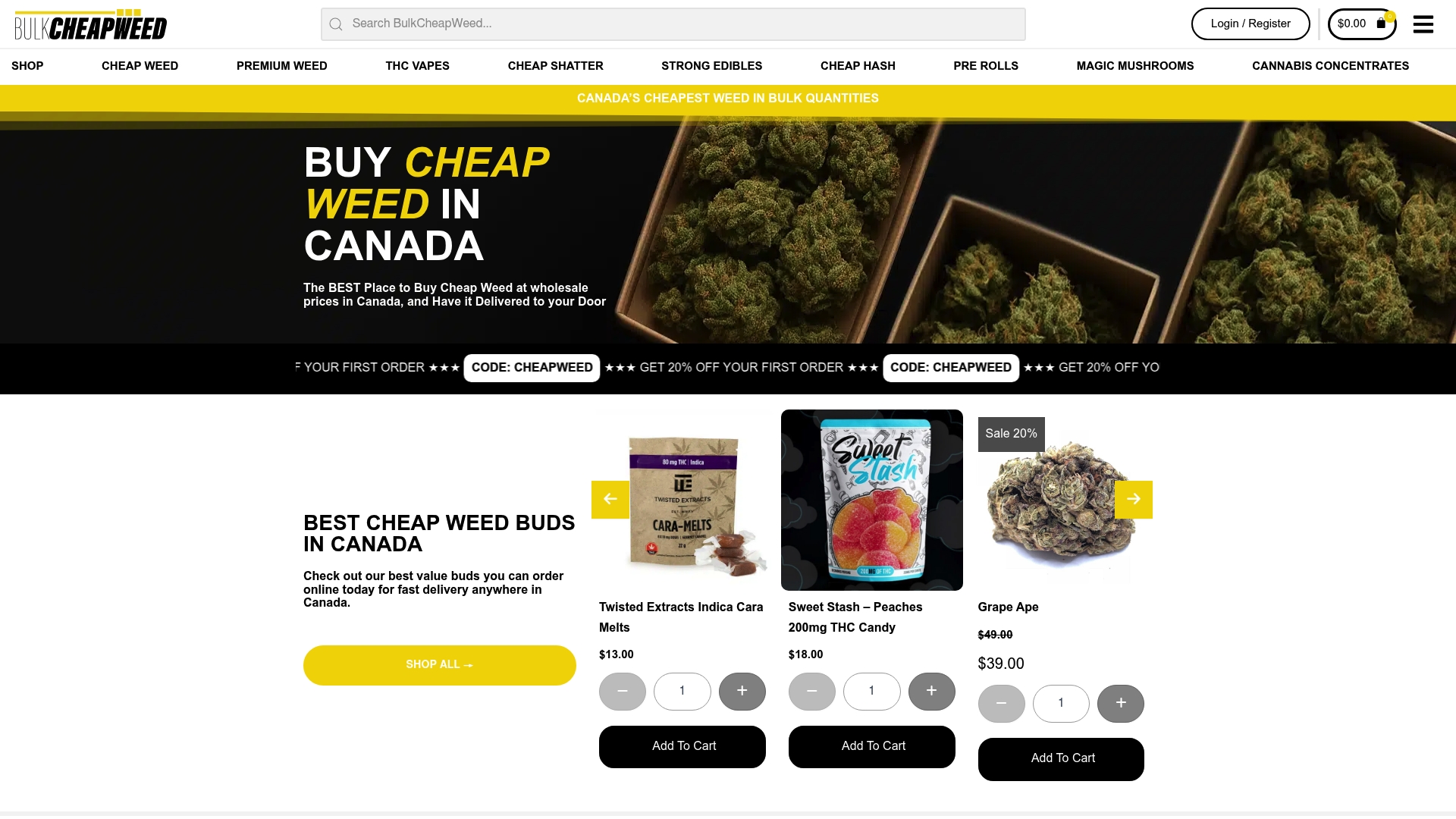
The edibles category includes lower-potency picks suited to beginners and anyone titrating carefully for sleep, alongside detailed buyer guides on how long edibles last so you can plan your timing before the order even arrives. Every order often ships discreetly, and bulk pricing can make testing a few different low-dose options more affordable. If you’re ready to build your titration plan around a product you can actually trust, browse the shop and start with the lowest milligram option that fits your target dose.
This article is general information, not a substitute for advice from a qualified doctor. Consult a qualified healthcare professional about your own circumstances before acting on anything here.
Sources
- Health Canada — Using cannabis products for medical purposes
- How to Use Cannabis Edibles for Sleep, A Doctor’s Guide — The Well (Northwell)
FAQ
What Is the Best Starting Dose for Sleep Edibles?
Most adults should start with 2.5 mg of THC, which Health Canada treats as a conservative clinical entry point. Increase only slowly if that dose doesn’t help after consistent use.
How Long Before Bed Should You Take a Sleep Edible?
Take your edible 60 to 90 minutes before you want to be asleep, since onset typically takes 30 to 90 minutes to begin.
Can Too High a THC Dose Make Sleep Worse?
Yes. Doses above roughly 10 to 15 mg are more likely to suppress REM sleep, increase nighttime wakefulness, and cause next-day grogginess instead of helping you sleep.
How Long Does an Edible’s Effect Last?
Effects commonly last 4 to 8 hours, which is why timing your dose well before bed matters more than with smoked cannabis.
Should You Redose If an Edible Isn’t Working After an Hour?
No. Wait at least 2 hours before considering another dose, since edible onset can take up to 90 minutes and redosing early is the most common cause of overconsumption.
Are Gummies or Tinctures Better for Precise Dosing?
Both work well, but gummies offer the most consistent milligram accuracy for most people, while tinctures allow finer dose adjustments through dropper measurements.