

Most potency differences between psychedelic mushrooms come from species and growing conditions, not the marketing name printed on a spore vendor’s label. Psilocybe cubensis is the most widely cultivated psilocybin species, and names like Golden Teacher or Penis Envy are cubensis variants rather than separate organisms. This guide covers the major species, the popular cubensis strains people ask about, realistic dosing ranges, the cultivation factors that actually move potency, and the safety information that matters more than any strain name.
TL;DR:
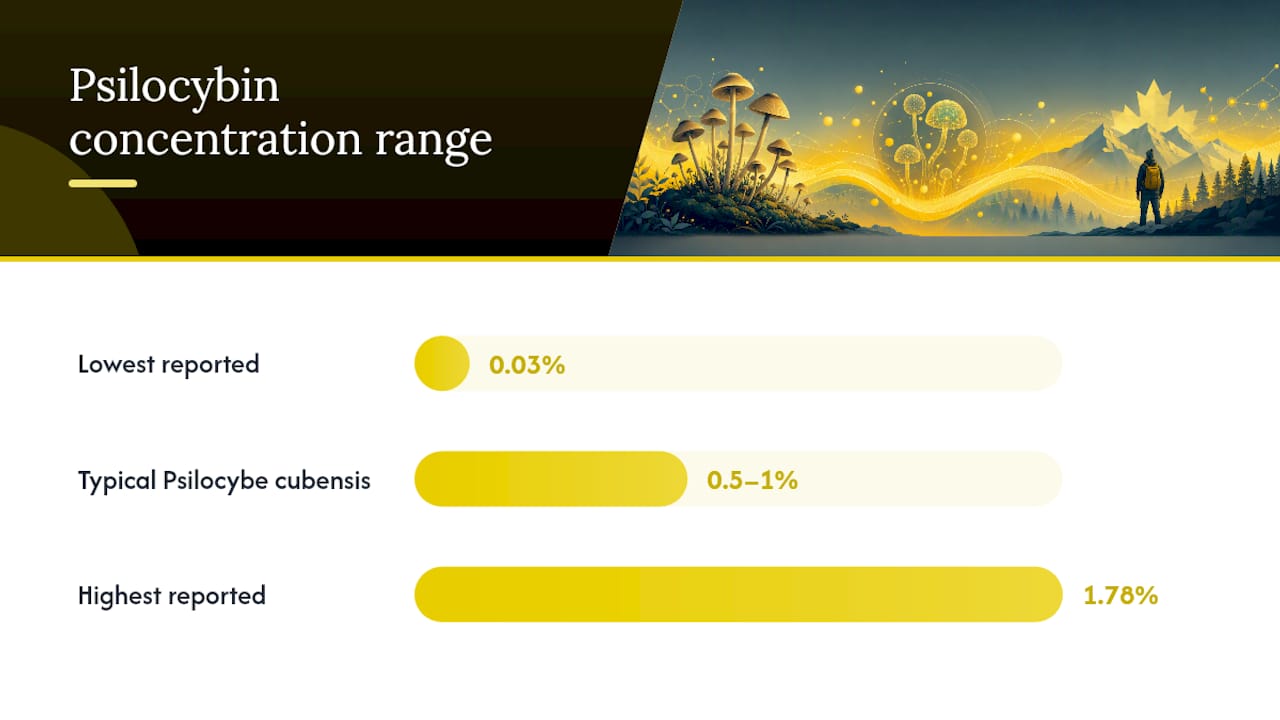
- Species like Psilocybe azurescens and Panaeolus cyanescens have much higher psilocybin content than cultivated Psilocybe cubensis strains, which typically range from 0.5% to 1%.
- Strain names such as Golden Teacher or B+ do not reliably indicate potency; complex cultivation factors like substrate, harvest time, and storage influence actual alkaloid levels.
- Cultivation conditions, especially substrate composition, humidity, temperature, and harvest timing, shape both yield and the mushroom’s psychoactive potency more than strain designation.
- Wild high-potency species are harder to source and identify safely, while most cultivated cubensis strains remain accessible and are more consistent in community-reported effects.
- Lab testing remains the only precise way to determine actual potency, as visual cues like bruising or cap size do not reliably reflect alkaloid content.
Table of Contents
- Species vs. Strains: What the Terms Actually Mean
- Major Psilocybin-Producing Species and Their Relative Potency
- Popular Psilocybe Cubensis Strains: What Sets Each Apart
- Potency, Dosing, and Why Strain Names Are a Poor Guide
- Cultivation Factors That Actually Shape Strain Expression
- Safety, Mental Health Risks, and Harm Reduction
- Legal and Availability Notes Worth Knowing Before You Read Further
- Why Supherbs and Bulk Cheap Weed Content Earns Trust
- Where These Strains Came From: A Short History
- How the Experience Itself Differs, Not Just the Strength
- How New Strains Get Made
- Telling Strains and Species Apart
- Myths Worth Retiring
- What This Guide Gets Right That Most Others Miss
- Sources
Species vs. Strains: What the Terms Actually Mean
A species is a distinct biological organism. A strain is a genetic variant within that species, the way a Honeycrisp and a Granny Smith are both apples but different cultivars. Psilocybe cubensis is a species. Golden Teacher, B+, and Penis Envy are strains of that one species, selected and propagated by growers for particular traits like color, fruiting speed, or reported strength.
This distinction matters because the gap between species tends to be far larger and more consistent than the gap between strains of the same species. A peer-reviewed review of Psilocybe cubensis cultivation notes that most recognized strain names, including the popular ones sold by spore vendors, are cubensis variants, and that genuine controlled data comparing their potency head to head is still thin. Meanwhile, species like Psilocybe azurescens routinely test with higher psilocybin content than typical cubensis, according to potency figures compiled on Wikipedia’s overview of psilocybin mushrooms.
So when someone claims a specific cubensis strain is “twice as strong” as another, treat that with skepticism. The stronger, better-documented driver of potency is usually one of these:
- Which species you are dealing with, since some wild species carry meaningfully higher alkaloid concentrations than domesticated cubensis.
- Substrate composition and nutrition during the growing cycle.
- Humidity and fresh air exchange during fruiting.
- Harvest timing, since psilocybin and psilocin levels shift as caps mature.
- Drying method and storage conditions after harvest.
Strain selection still matters for practical reasons, like growth speed or resilience for a new cultivator, but if potency is the question, species and cultivation conditions carry more weight than the name on the jar.
Major Psilocybin-Producing Species and Their Relative Potency
Before comparing individual cubensis strains, it helps to know the species landscape they sit inside. A handful of genera produce most of the psilocybin mushrooms people encounter, whether cultivated or found in the wild, and their potency ranges differ enough to matter.
Psilocybe cubensis is the workhorse species of home cultivation. It tolerates a wider range of substrates and temperatures than most wild species, which is exactly why nearly every popular named strain (Golden Teacher, B+, Penis Envy, and dozens more) traces back to it. Typical dried cubensis samples run in the range of roughly 0.5% to 1% psilocybin by dry weight, though reported figures vary by source and testing method, per the potency data cited on Wikipedia’s psilocybin mushroom entry.
Psilocybe semilanceata, commonly called the liberty cap, grows wild in grassy fields across parts of Europe and North America. It is small, easy to misidentify without experience, and generally considered moderate to strong in potency relative to typical cubensis.
Psilocybe azurescens is one of the most potent psilocybin species documented in the literature. It grows natively along parts of the Pacific coast, often in sandy soil near dune grass, and its psilocybin content can run notably higher than cubensis in reported samples.
Psilocybe cyanescens, sometimes called wavy caps, is another wild species associated with wood chips and forest litter. Like azurescens, it tends to test on the higher end of the potency spectrum compared with cultivated cubensis.
Psilocybe mexicana carries deep historical significance as one of the species used in Mesoamerican ceremonial contexts long before Western science identified psilocybin. Its potency is generally milder than azurescens or cyanescens.
Panaeolus cyanescens, sometimes called blue meanies in casual conversation (a naming overlap that confuses a lot of beginners, since there is also a cubensis strain called Blue Meanie), is a separate genus entirely. Wild Panaeolus cyanescens is often reported as quite potent, and some cultivators grow it deliberately for that reason.
Here is the practical availability gap worth understanding: cultivated cubensis strains are accessible, well-documented, and forgiving for beginners. Wild high-potency species like azurescens and cyanescens are harder to source, harder to identify safely, and generally recommended only for people with real foraging experience or established cultivation setups.
A quick potency snapshot: literature-cited psilocybin concentrations across psilocybin mushrooms span a wide range, roughly 0.03% up to 1.78% of dry weight depending on species and sample, with most cultivated cubensis clustering well below the top of that range, according to the synthesis on Wikipedia’s psilocybin mushroom page. That spread alone explains why two mushrooms that look similar can produce very different experiences.
Experienced users chasing higher potency tend to gravitate toward these wild species rather than toward high-potency cubensis strains, precisely because the species-level ceiling is higher. That is a meaningful nuance most beginner guides skip.
Popular Psilocybe Cubensis Strains: What Sets Each Apart
Cubensis strains dominate the cultivation world because the species itself is forgiving. Below are the names you will run into most often, with realistic notes on perceived potency, who each one suits, and how demanding it is to grow. Treat “potency” here as relative and community-reported rather than lab-certified, since consistent, controlled comparisons across strains remain limited.
-
Golden Teacher. The strain most beginners start with. Golden Teacher has a reputation for moderate, balanced effects and a growth pattern that tolerates minor mistakes in substrate or humidity, making it a common first pick for new cultivators.
-
B+. Known as one of the most substrate-flexible cubensis strains, B+ grows large fruiting bodies and adapts to a wide range of grain and bulk substrates. Potency is generally reported as moderate, similar to Golden Teacher, with a reputation for reliability over raw strength.
-
Penis Envy. The community benchmark for high potency among cubensis strains. Its thick, dense stems and slower colonization make it noticeably harder to cultivate, and research into strain variability points to Penis Envy as both more potent and more sensitive to cultivation conditions than mainstream strains. Recommended for cultivators with prior experience, not a first grow.
-
Albino Penis Envy (APE). A lighter-pigmented variant of Penis Envy that carries a similar strength reputation. APE tends to be even more finicky about humidity and light exposure than standard Penis Envy, which pushes it further into “experienced grower” territory.
-
Mazatapec. A strain with roots tracing to Oaxaca, Mexico, and historical ties to traditional ceremonial use of Psilocybe mexicana in the same region. Mazatapec is generally described as moderate in potency with a more introspective, less visually intense effect profile, and it grows at a manageable pace for intermediate cultivators.
-
Cambodian. Fast-fruiting and forgiving, Cambodian is often recommended alongside Golden Teacher and B+ for beginners. Potency runs moderate, and its quick life cycle makes it a good strain for learning the full cultivation process without a long wait.
-
Blue Meanie. Not to be confused with the wild Panaeolus cyanescens sometimes given the same nickname, this cubensis strain is reputed to bruise blue easily and is generally considered moderately potent, with a reputation for vigorous, dense fruiting.
-
McKennaii. Named in reference to Terence McKenna, this strain has a reputation for a more visually engaging experience alongside moderate to strong potency. Cultivation difficulty sits in the middle, better suited to growers who have completed at least one successful flush of an easier strain first.
-
Jack Frost. A strain that produces frosty-looking mycelium and is generally reported as moderate in potency. It is less commonly discussed than the strains above, and reliable cultivation data is comparatively sparse.
-
Enigma. A cubensis mutation that grows as a dense, brain-like mass rather than typical caps and stems. Enigma’s potency reports vary widely, and its unusual growth pattern makes it one of the more challenging and unpredictable strains to cultivate successfully.
Pro Tip: Bruising blue on a mushroom’s stem is often treated as a potency signal, but it only reflects psilocin oxidizing where the tissue was damaged. It is not a reliable measure of total alkaloid content, and lab testing remains the only way to know actual potency with any precision, a point echoed in community potency writeups on landrace species.
Every strain-specific potency claim above should be read as a community-reported tendency, not a guarantee. Two Golden Teacher fruiting bodies from different grows, different substrates, and different harvest windows can vary meaningfully in strength.
Potency, Dosing, and Why Strain Names Are a Poor Guide
Strain labels tell you almost nothing precise about how strong a specific batch of mushrooms will be. Dosing decisions should be based on gram ranges and cautious personal calibration, not on a strain’s reputation.
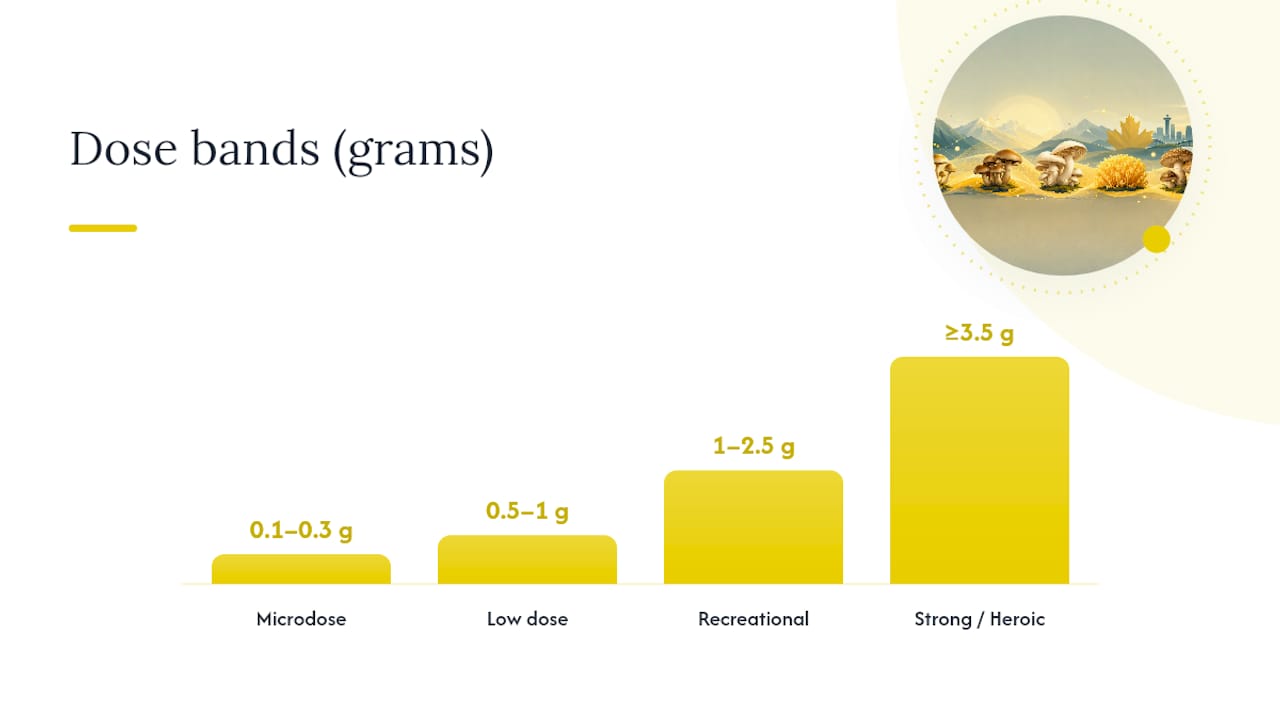
Rough dose bands commonly referenced in harm-reduction resources look like this:
- Microdose: roughly 0.1 to 0.3 grams of dried mushroom, generally sub-perceptual or barely noticeable.
- Low dose: roughly 0.5 to 1 gram, producing mild sensory and mood shifts.
- Common recreational dose: roughly 1 to 2.5 grams, producing noticeable visual and cognitive effects for most people.
- Strong or “heroic” dose: 3.5 grams and above, associated with intense perceptual and ego-dissolving effects and a meaningfully higher risk of a difficult experience.
Because psilocybin content in dried cubensis typically falls somewhere between roughly 0.5% and 1% by dry weight, per the ranges collected on Wikipedia’s psilocybin mushroom page, a 1 gram dose can translate to a fairly wide range of actual psilocybin milligrams depending on the specific mushroom. That single fact explains why two people eating “1 gram” of mushrooms from different sources can have noticeably different experiences.
Several factors push potency around far more than the strain name does: substrate nutrition, humidity during fruiting, how mature the caps were at harvest, and how the mushrooms were dried and stored afterward. Drying too hot or storing mushrooms with oxygen exposure can degrade alkaloid content over time, according to research on cultivation influences on metabolite production.
Basic harm-reduction dosing rules apply regardless of strain: start with a low dose if you are new to a batch, wait at least 45 to 60 minutes before assuming a dose “isn’t working,” and have a sober sitter present for anything above a low dose. Bulkcheapweed’s mushroom dosage chart breaks these bands down further for readers calibrating a first dose, and the microdosing guide covers the lower end of that range in more detail.
Cultivation Factors That Actually Shape Strain Expression
Strain genetics set a ceiling, but growing conditions decide whether a batch gets anywhere close to it. This section covers the variables that matter, framed as background knowledge rather than a step-by-step growing protocol, since cultivation legality varies by jurisdiction and any hands-on cultivation should be researched against local law first.
Substrate composition affects both yield and alkaloid expression. Grain-based substrates, straw, and manufactured “bulk” mixes each supply different nutrient profiles, and the PMC review of Psilocybe cubensis cultivation notes that research directly linking specific substrate formulas to specific potency outcomes is still limited, even though growers widely believe substrate choice matters.
Humidity and fresh air exchange (FAE) shape fruiting body development. Too little fresh air produces stunted, thin-stemmed mushrooms; too much can dry out a fruiting chamber and stress the mycelium. Both extremes are associated with lower yield and inconsistent cap development.
Temperature during colonization and fruiting shifts growth speed and, by extension, harvest timing. Warmer conditions generally speed up the life cycle, while cooler conditions slow it down and can change cap morphology.
Harvest timing is one of the more underappreciated levers. Psilocybin and psilocin concentrations change as a mushroom matures, and picking too early or too late relative to spore release can shift the final alkaloid profile, a pattern discussed in research on cultivation influences on metabolite levels.
This is also why certain strains earn a “beginner-friendly” reputation. Golden Teacher, B+, and Cambodian tend to tolerate imperfect sterile technique and fluctuating humidity better than more delicate strains like Penis Envy, which is a genuine vigor difference rather than just folklore repeated in grow forums.
Contamination is the single biggest practical risk in any cultivation attempt, cubensis or otherwise. Mold and bacterial competitors can overtake a substrate quickly, and consuming contaminated mushrooms carries real health risk separate from psilocybin itself. Anyone considering cultivation should treat sterile technique as a safety issue, not just a yield issue, and should confirm the legal status of cultivation in their own jurisdiction before proceeding.
Pro Tip: If you are researching cultivation purely to understand potency variation rather than to grow mushrooms yourself, focus on harvest timing and drying method. Those two factors are the easiest to observe in secondhand grow reports and explain more potency variation within a single strain than most people expect.
Safety, Mental Health Risks, and Harm Reduction
Psilocybin is not appropriate for everyone, and strain choice does nothing to change that. People with a personal or family history of psychosis or schizophrenia face an elevated risk of triggering or worsening psychotic symptoms, a risk factor highlighted in NIDA’s overview of psilocybin research. Certain medications, particularly some antidepressants and mood stabilizers, can interact with psilocybin in ways that are not fully predictable, which makes a conversation with a healthcare provider worthwhile before combining substances.
A practical harm-reduction checklist looks like this:
- Start with a low, measured dose, especially with an unfamiliar batch or strain.
- Weigh dried mushrooms rather than eyeballing quantity.
- Choose a familiar, low-stress setting rather than an unpredictable environment.
- Have a sober sitter present, particularly at recreational or higher doses.
- Know your plan if things go wrong: a quiet space, water, and a way to contact help if genuine distress or a medical emergency develops.
- Avoid mixing with alcohol or other psychoactive substances.
Microdosing carries a separate safety note worth flagging honestly: the evidence base for its claimed benefits is still developing, and much of the current data relies on self-report rather than controlled trials, a limitation NIDA’s research summary acknowledges directly. Treat microdosing as a personal experiment with real unknowns, not a settled protocol.
On the numbers: psilocybin content across species and strains spans roughly a 50-fold range, from about 0.03% to 1.78% of dry weight in documented samples, according to the figures compiled on Wikipedia’s psilocybin mushroom entry. That spread is exactly why fixed dosing advice based on grams alone will always carry uncertainty.
Legal and Availability Notes Worth Knowing Before You Read Further
Legal status for psilocybin mushrooms varies significantly by jurisdiction, and it changes over time as policy evolves. What is true in one province, state, or country is often not true a short drive away, and strain names carry zero legal weight of their own.
Rather than relying on general claims found in strain guides or forum posts, verify current rules through official federal or provincial government sources for your own location before making any decisions. Treat any legal information in a strain guide, this one included, as background context rather than legal advice, and confirm specifics with an official source or a legal professional if you have questions about your own situation.
Why Supherbs and Bulk Cheap Weed Content Earns Trust
Supherbs oversees the strain and dosage content published across Bulkcheapweed, drawing on peer-reviewed cultivation research and public health sources like NIDA rather than forum consensus alone. Every potency claim in this guide traces back to a citable source, and every dosing recommendation aligns with harm-reduction principles rather than marketing copy.
Bulkcheapweed’s own mushroom dosage chart and microdosing guide extend the dosing framework covered here in more granular detail, and the strongest shroom strains breakdown digs deeper into potency comparisons for readers who want more strain-by-strain nuance. The editorial approach throughout favors conservative, sourced claims over strain hype, particularly around potency figures that are easy to exaggerate without lab data behind them.
Where These Strains Came From: A Short History
Psilocybin mushroom use predates Western science by centuries. Psilocybe mexicana held ceremonial significance among Indigenous groups in Mesoamerica long before psilocybin was isolated as a compound in the mid-20th century. Mazatapec, one of today’s popular cubensis strains, takes its name directly from the Mazatec region of Oaxaca associated with that tradition.
Golden Teacher’s origin story is murkier. It surfaced in North American grow communities sometime in the 1980s or 1990s, and its name is generally attributed to its balanced, approachable effects rather than to any documented lineage. Penis Envy has a more traceable, if informal, history tied to grower communities experimenting with mutant cubensis phenotypes that produced unusually dense, thick fruiting bodies.
McKennaii’s name is a direct nod to Terence McKenna, whose writing and lectures in the late 20th century did more than almost anyone else to popularize psilocybin mushrooms in Western counterculture. Blue Meanie borrows its name from Beatles folklore, an example of how casual, sometimes unserious naming conventions became permanent fixtures in cultivation culture, occasionally at the cost of clarity, given the unrelated wild Panaeolus cyanescens that shares the nickname.
How the Experience Itself Differs, Not Just the Strength
Potency is only part of the picture. Strains and species differ in how the experience actually feels, independent of raw dose.
Some strains, including McKennaii and certain Penis Envy variants, are more frequently described as producing intense visual effects, geometric patterning, and stronger perceptual distortion at comparable doses. Others, like Mazatapec, tend to get described in more introspective, emotionally focused terms with less visual intensity.
Duration also varies somewhat by dose and individual metabolism more than by strain specifically, though wild species like Psilocybe azurescens are sometimes reported producing a more intense come-up and peak. Most psilocybin experiences run four to six hours from onset to resolution regardless of species, but the emotional texture, whether contemplative, euphoric, or challenging, depends heavily on mindset and setting as much as on the mushroom itself.
Body load, meaning physical sensations like nausea or heaviness, also differs across ingestion methods more than strain. That is one reason methods like tea preparation have grown popular as an alternative to eating dried mushrooms directly, a comparison covered in Bulkcheapweed’s shroom tea versus eating guide.
How New Strains Get Made
Strain development in cubensis largely happens through selective breeding and spontaneous mutation rather than genetic engineering. Growers isolate spores or tissue from fruiting bodies that display a desired trait, whether that is size, color, growth speed, or reported potency, and propagate that genetic line in controlled conditions.
Enigma represents an extreme case: a spontaneous mutation that abandoned typical cap-and-stem morphology entirely in favor of a dense, cerebral-looking mass. Albino Penis Envy similarly arose from selective propagation of a lighter-pigmented Penis Envy phenotype rather than crossbreeding with a separate strain.
Genuine cross-strain breeding, deliberately combining genetics from two distinct strains to create a new hybrid, does happen in more advanced cultivation circles, but reliable public documentation of specific crosses and their resulting traits remains limited. Most of what circulates as strain lineage information is grower-reported rather than laboratory-verified, which is worth remembering before treating any strain’s backstory as settled fact.
Telling Strains and Species Apart
Distinguishing species in the wild requires real expertise; cap shape, spore print color, habitat, and bruising pattern all factor in, and misidentifying a wild mushroom carries genuine poisoning risk from toxic lookalikes. This is not a skill to learn from photos alone.
In cultivation, distinguishing cubensis strains from each other is honestly difficult without documentation, since most strains share the same basic golden brown cap and white stem structure. Growers typically rely on tracked genetics, meaning they know the strain because they started with labeled spores or a documented culture, not because the mushroom looks visibly distinct on the shelf.
A few strains stand out visually: Enigma’s brain-like mass, Albino Penis Envy’s pale coloring, and Penis Envy’s unusually thick, often capless stem. Beyond those exceptions, treat visual identification of cubensis strains with real skepticism, and rely on labeled genetics and, where potency matters, lab testing rather than appearance.
Myths Worth Retiring
A few misconceptions circulate often enough to correct directly. Bruising intensity does not reliably indicate potency; it mainly reflects how much psilocin oxidized at the point of physical damage, not the mushroom’s total alkaloid content, according to community potency analysis of landrace species.
Cap color and size are not reliable potency indicators either, despite how often that claim shows up in casual conversation. Golden Teacher and B+ can produce visually large, impressive fruiting bodies without being any stronger than smaller specimens.
“Blue Meanie” also causes genuine confusion, since it refers both to a moderate cubensis strain and, colloquially, to the wild species Panaeolus cyanescens, which is a different organism with a different potency profile. And the belief that all wild mushrooms are automatically stronger than cultivated ones is only partly true. It holds for species like azurescens and cyanescens, but plenty of wild psilocybin species test at or below typical cubensis potency.
What This Guide Gets Right That Most Others Miss
The biggest failure in most strain content is treating cubensis strain names as if they carry the same weight as species differences. They don’t. A Golden Teacher and a B+ are far more alike than a cultivated cubensis and a wild Psilocybe azurescens, and conflating the two leads people to make dosing decisions based on marketing rather than biology.
The conventional advice to “just start low” is fine but incomplete. Starting low matters less than knowing which variable actually shifted the potency of your specific batch, whether that’s species, harvest timing, or storage. Readers should prioritize understanding those mechanics over memorizing strain trivia. Beginners are better served picking a forgiving, well-documented cubensis strain and paying close attention to dose and setting than chasing a strain reputed to be the strongest. Potency chasing without lab-verified data is largely guesswork dressed up as expertise.
— Supherbs
This article is general information, not a substitute for advice from a qualified doctor. Consult a qualified healthcare professional about your own circumstances before acting on anything here.
Sources
The claims in this guide draw primarily from a peer-reviewed review of Psilocybe cubensis cultivation and genetics, which covers strain variability and research gaps, and a study on cultivation factors affecting psilocybin production, which supports the potency and cultivation-difficulty claims about Penis Envy specifically. Safety and risk information comes from NIDA’s psilocybin research overview. Taxonomy and broad potency ranges are drawn from Wikipedia’s psilocybin mushroom entry, used alongside the peer-reviewed sources above rather than as a standalone authority.
- Exploring Psilocybe cubensis Strains: Cultivation Techniques, Psychoactive Compounds, Genetics and Research Gaps
- MDPI J Fungi: Strain variability and cultivation influences on psilocybin production
- NIDA: Psilocybin (magic mushrooms) research topics
- The Third Wave: Psilocybe natalensis — potency and characteristics
- Psilocybin mushroom — Wikipedia