

Yes, rural Canadians can order cannabis legally by mail from licensed provincial retailers, and the most reliable route is tracked, proof-of-age shipping or post-office pickup through an authorized seller. Before you order, confirm the retailer appears on your province’s authorized list, choose a shipping option with tracking and signature or proof-of-age, and keep the tracking number until the parcel arrives. Rural weed shipping in Canada works well when you follow these three checks.
TL;DR:
- Confirm the retailer appears on your province’s authorized list and chooses tracked, proof-of-age shipping options with signature confirmation.
- Expect delivery times of 1 to 8 business days, with rural routes possibly causing tracking delays or longer transit periods.
- Ensure the parcel has intact tamper-evident seals, matching labels, an excise stamp if duty-paid, and anonymous external packaging per federal regulations.
- Use pickup options like Canada Post FlexDelivery if your rural route has issues with address ambiguity or delivery attempts.
- Avoid sellers promising cross-border shipping, accepting untraceable payments, or claiming to ship nationwide without provincial authorization.
Table of Contents
- How rural mail-order cannabis actually works
- Packaging rules and what a legal parcel should look like
- Province-by-province checklist for rural shipping
- Shipping options, timelines, and rural delivery realities
- Spotting illegal sellers before you pay
- What rural delivery experience actually looks like in practice
- Bulk Cheap Weed: discreet shipping and service for rural Canadians
- A closing note on shipping cannabis to rural addresses
- Sources
- FAQ
How rural mail-order cannabis actually works
Ordering cannabis by mail is straightforward once you know the sequence. The process differs a little from ordering a regular parcel because both the retailer and the carrier have to follow federal and provincial rules built around age verification and controlled hand-off.
- Confirm the retailer is listed on your province’s authorized-retailer table and that it ships to your postal code.
- Check out and choose your delivery method: home delivery with signature or Proof of Age, or pickup through Canada Post’s FlexDelivery service at your local post office.
- Select tracked shipping at checkout, pay through the retailer’s approved payment method, and save your tracking number somewhere you will actually check it.
- Add a few extra transit days to your expected delivery window if you live outside a major delivery route.
- Bring government photo ID to pickup or have it ready at your door, since acceptable ID types vary slightly by province.
Post-office pickup solves a problem a lot of rural buyers do not think about until it happens: address ambiguity. Rural route numbers, unmarked driveways, and shared mailboxes can all cause a courier to miss a delivery attempt. Routing the parcel to the nearest post office through FlexDelivery means it waits for you in a controlled location instead of sitting on a porch or getting sent back.
Home delivery still works well for most addresses, especially when a retailer’s checkout confirms your postal code is served. The retailer’s own shipping and payment pages should confirm this before you pay, and a legitimate seller will always let you check delivery details or verify a checklist for buying online before completing an order.
Whichever option you pick, the ID step is not optional. Canada Post’s Proof of Age option means the delivery agent may ask for photo ID if you look under 30, and will record your name and signature regardless of whether you are the original addressee. Knowing this ahead of time means no surprises at the door or the counter.
Packaging rules and what a legal parcel should look like
Federal rules govern how cannabis is packaged long before it reaches a courier truck. Under the Cannabis Regulations, every immediate retail container has to be child-resistant, tamper-evident, and opaque or translucent, and it cannot hold more than 30 grams of dried cannabis equivalent. That limit applies per container, not per order, so a bulk purchase typically arrives as multiple sealed units rather than one oversized package.

On top of packaging design, duty-paid cannabis carries an excise stamp. The CRA’s excise-duty guidance explains that licensed producers are responsible for affixing these stamps before product enters the retail market, and the absence of a stamp generally signals the duty has not been paid.
The federal packaging rule caps dried cannabis at 30 grams per immediate retail container, a limit set out directly in the Cannabis Regulations. That single detail explains why larger orders ship in several sealed units instead of one big bag.
Canada Post layers its own requirements on top of the federal ones. Shipments have to use anonymous outer packaging with no branding or contents description, and odour has to be controlled so nothing is detectable from outside the box. When you open a parcel from a legitimate retailer, a few things should be true:
- The inner tamper-evident seal is intact and has not been opened or resealed.
- Retail labels match what you ordered, including strain name and weight.
- An excise stamp is visible on duty-paid products where applicable.
- The outer packaging gives no indication of contents.
- Nothing looks repackaged, relabeled, or inconsistent with what appeared at checkout.
If something is missing, damaged, or does not match your order, contact the retailer directly before opening or using the product. A discreet-shipping explainer can walk you through what a compliant parcel typically looks like from the outside in. The anonymous outer packaging is not just about privacy either, it is a regulatory requirement that happens to also protect rural buyers from unwanted attention on shared rural mail routes or community mailboxes.
Province-by-province checklist for rural shipping
Provinces and territories each run their own retail model, and that affects who can legally sell to you and how. Health Canada’s provincial authorization table lays out how each jurisdiction handles retail and distribution, and it is the fastest way to confirm a seller is actually authorized to ship where you live.
Minimum age also varies by province, and checkout systems are supposed to enforce whatever applies in your jurisdiction. Because rules differ, run through this quick list before you commit to an order:
- Ontario: Confirm the retailer appears on the province’s authorized list and that checkout enforces the correct minimum age.
- British Columbia: Check that the seller’s shipping coverage includes your postal code and confirm excise-stamp handling at checkout.
- Alberta: Verify authorization status directly against the provincial retailer list rather than assuming a seller’s own claims.
- Saskatchewan: Confirm product availability, since retail selection can differ from other provinces.
- Manitoba: Check that the retailer’s delivery zone actually covers rural routes and not just major centers.
- Quebec: Confirm the minimum age enforced at checkout, since it differs from most other provinces.
None of these checks take more than a minute or two, and they matter more in rural areas because a shipping error is harder to fix quickly when the nearest retail alternative is an hour away. When in doubt, cross-reference the seller against Health Canada’s table rather than relying on marketing language on the retailer’s own site.
Shipping options, timelines, and rural delivery realities
Canada Post offers a few tracked service levels for cannabis shipments, and the option you pick affects both speed and the level of control over hand-off. Priority and Xpresspost tend to move fastest, while Expedited Parcel is slower but still tracked and eligible for Proof of Age or signature service.
- Choose Proof of Age or signature service whenever it is offered, since it documents exactly who received the parcel and when.
- Expect delivery windows of roughly 1 to 8 business days depending on service level and how remote your postal code is.
- Plan pickup trips around your local post office’s hours if you choose FlexDelivery, since rural outlets often keep shorter or split hours than urban branches.
- Check tracking regularly rather than waiting until the expected delivery date, since rural hops can show gaps between scan events.
Tracking on rural routes does not always update as smoothly as it does in cities. A parcel may show movement between major sorting centers, then go quiet for a day or two while it transfers to a local post office or gets bundled into a rural mail route. That gap is normal and does not usually mean anything has gone wrong. If tracking stalls for several days beyond the expected window, contact the retailer or Canada Post directly rather than assuming the worst. A tracking walkthrough covers what typical scan patterns look like and when a delay is actually worth escalating.
Pro Tip: Set a calendar reminder for the day your tracking should update, and check it once rather than refreshing the page five times a day. Rural scan gaps are common and usually resolve within a day or two.
Spotting illegal sellers before you pay
Most of the risk in rural cannabis shipping comes from choosing the wrong seller, not from the shipping process itself. A handful of warning signs cover most of the illegal or unreliable operators out there.
- Be wary of any site promising cross-border shipping into or out of Canada. Federal and CBSA rules make unauthorized cannabis movement across the border illegal, and rural location does not change that.
- Avoid sellers that only accept e-transfer to a personal account or cryptocurrency with no other payment option, since legitimate retailers offer traceable, retailer-branded payment processing.
- Treat “we ship anywhere” claims with skepticism. Legitimate retailers validate your postal code against provincial coverage rather than promising blanket nationwide delivery with no restrictions.
- Confirm the seller appears on your province’s authorized-retailer list before paying anything.
- If a parcel already in transit seems to have come from an unauthorized source, do not accept or open it, and report the concern to the carrier or the appropriate provincial regulator.
Also remember that gig delivery apps are not a lawful channel for cannabis in Canada. DoorDash’s own Canadian merchant guidance covers alcohol delivery practices but does not list cannabis as a supported product, so any claim that a food delivery app can bring you weed should be treated as false. Stick to a licensed retailer’s own shipping channel or Canada Post services built for Proof of Age and signature confirmation.
What rural delivery experience actually looks like in practice
Retailers that ship into rural Canada regularly build their packing process around two constraints: odour control and address uncertainty. Outer boxes are sealed without branding, inner contents are cushioned to prevent shifting during longer transit times, and shipping labels are checked against the destination’s serviceability before the order is even packed.
Choosing between pickup and home delivery usually comes down to how reliable your specific address is for courier drop-off. If your route has a shared mailbox, no clear driveway marker, or a history of missed delivery attempts, FlexDelivery pickup at the local post office removes that variable entirely. If your address has always received parcels without issue, home delivery with Proof of Age tends to be simpler and faster.
Rural cannabis buyers do not need special treatment from the law. They need a checkout process that actually confirms their postal code is served and a shipping option that accounts for how rural routes really move.
— Supherbs
Bulk Cheap Weed: discreet shipping and service for rural Canadians
A retailer sells a variety of cannabis products at bulk pricing, built for buyers who want quality without paying single-gram markups. The company’s positioning centers on wholesale pricing for bulk orders, a wide product range, and fast, discreet delivery backed by a customer satisfaction guarantee.
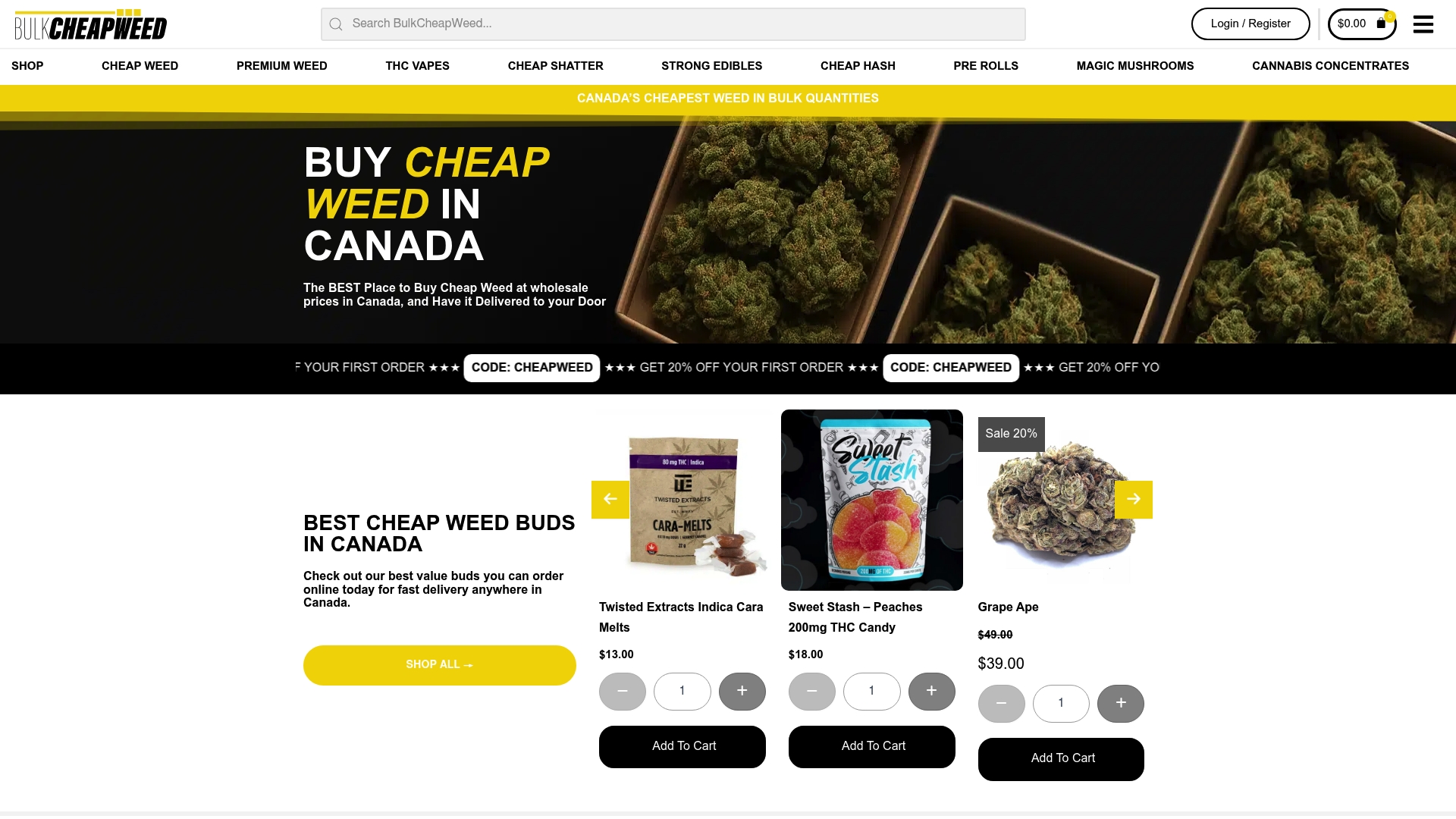
Rural buyers get checkout protections including validation of province and postal code before an order goes through, so shipping coverage is known before payment.
- Browse the full product catalog across flower, shatter, hash, edibles, vapes, concentrates, and mushrooms.
- Review the discreet shipping process to see how orders are packed for anonymity and odour control.
- Check serviceability to your postal code at checkout before finalizing payment.
If you are weighing strain options before you order, this comparison of photoperiod, autoflower, and fast-version strains is a useful outside reference for flower buyers. When you are ready, start with the Bulk Cheap Weed shop and confirm delivery to your address before checkout.
A closing note on shipping cannabis to rural addresses
Sticking to licensed retailers and tracked, proof-of-age shipping is not just a legal formality, it is what actually protects rural buyers from missed deliveries, seized parcels, and payment scams. The rules exist because cannabis is a controlled product, but once you understand them, ordering by mail is genuinely simple. Confirm the retailer, pick the right shipping method for your address, and keep your tracking number handy. Check the sources above whenever a detail feels uncertain, and use a retailer’s own discreet-shipping page to see exactly what to expect before your parcel arrives.
Sources
Rather than taking any single retailer’s word for it, these are the primary sources worth bookmarking:
- Sending and receiving cannabis | Personal | Canada Post
- Cannabis Regulations (SOR/2018-144) — Packaging requirements
- Canada
- DoorDash help — Canada alcohol sales (merchant guidance)
When something looks unclear, your province’s own retailer lookup is the fastest way to settle it.
FAQ
Is it illegal to order weed online in Canada?
No, ordering cannabis online is legal in Canada as long as you buy from a retailer authorized in your province and the shipment follows federal packaging and carrier rules. Check your seller against Health Canada’s provincial retailer table before ordering to confirm it is legitimate.
Does DoorDash deliver weed in Canada?
No, DoorDash’s own Canadian merchant guidance covers alcohol delivery but does not list cannabis as a supported delivery product. Cannabis should be ordered directly through a licensed retailer’s shipping channel or Canada Post, not through gig food delivery apps.
What is $40 worth of weed called?
There is no official or standardized name for a specific dollar amount of cannabis, since pricing and quantity vary by retailer, strain, and product type. The clearest way to know what you are getting for a given price is to check the exact gram weight and product listed at checkout rather than relying on slang terms.
How long does cannabis take to ship to a rural address?
Delivery typically takes between 1 and 8 business days depending on the carrier service chosen and how remote the destination is, based on Canada Post’s tracked shipping options. Rural addresses often fall toward the longer end of that range, so building in extra time is worth doing before you order.
What should I check when my cannabis parcel arrives?
Look for an intact tamper-evident seal, retail labels matching your order, and an excise stamp on duty-paid products, all features required under the Cannabis Regulations. If anything looks damaged, mismatched, or missing, contact the retailer before opening or using the product.