

Cannabis can help some Canadians fall asleep faster, but it is not a guaranteed fix and it works differently depending on the cannabinoid, dose, and format. Low-dose THC and CBD-dominant products tend to help most with sleep onset and anxiety-driven wakefulness, while high doses often backfire. If insomnia has lasted more than a few weeks, Health Canada recommends talking to a clinician before treating it yourself.
TL;DR:
- Low-dose THC (1 to 5 mg) can help reduce sleep onset time, but higher doses tend to fragment sleep and increase wakefulness.
- CBD primarily aids sleep by reducing anxiety, making it suitable for anxiety-driven insomnia rather than purely physical sleep issues.
- Edibles last 6 to 8 hours and take 1 to 2 hours to begin working, requiring careful dosing to avoid overconsumption and extended grogginess.
- Checking cannabinoid ratios and terpene profiles on product labels provides more reliable indications of sleep aid potential than strain type labels like indica or sativa.
- Regular users should start with small doses, wait a full week before increasing, and avoid combining multiple doses before the first has taken effect.
Table of Contents
- Weed for Sleep in Canada: What the Evidence Actually Shows
- How to Dose Cannabis for Sleep Without Overdoing It
- Flower, Vapes, Edibles, or Tinctures: Which Format Fits Your Sleep Problem
- What to Actually Check on the Label Before You Buy
- The Risks Nobody Puts on the Front Label
- How Bulkcheapweed Approaches Sleep-Focused Products
- Why Terpenes Beat Strain Names Every Time
- Ready to Try a Lab-Tested Option Tonight?
- Sources
Weed for Sleep in Canada: What the Evidence Actually Shows
THC’s effect on sleep depends almost entirely on dose. Health Canada’s clinical guidance for practitioners points to human experimental data showing low doses of THC can shorten the time it takes to fall asleep and may increase total sleep time. Push the dose higher, though, and the same compound starts working against you, fragmenting sleep and increasing the odds of waking up through the night. That’s the central paradox of using THC strains for sleep: more is not better, and the effective window is narrow.
CBD’s story is different. Peer-reviewed research on cannabinoids and sleep suggests CBD oil for sleep works mainly by lowering anxiety rather than sedating the body directly, which is why it tends to help people whose insomnia is anxiety-driven more than people with purely physical sleep disruption. CBN has a reputation as a sleep-specific cannabinoid, but the clinical evidence behind that claim remains thin. Most of what circulates about CBN and sleep is still anecdotal rather than clinically established.
Zoom out to the research landscape and the picture gets messier. A systematic review of cannabis and sleep found real improvements in specific groups, like people with anxiety-related sleep problems, but no consistent benefit for chronic insomnia broadly. That inconsistency matters if you’re comparing weed for sleep against something like melatonin or CBT-I, which have more uniform trial results.
By the numbers: Health Canada’s Canadian Cannabis Survey tracks sleep as one of the recurring reasons Canadians report for cannabis use, alongside pain and anxiety. It’s a common motivation, not a niche one.
What tends to hold up across the research:
- Low-dose THC (roughly 1 to 5 mg) shows the clearest signal for reducing time to fall asleep.
- CBD’s benefit for sleep looks indirect, working through anxiety reduction rather than sedation.
- High-THC products carry a real risk of disrupting sleep architecture, not just improving it.
- Evidence for CBN specifically as a sleep aid is weaker than marketing suggests.
How to Dose Cannabis for Sleep Without Overdoing It
“Start low, go slow” isn’t a slogan, it’s the practical backbone of Health Canada’s dosing guidance, and it matters more for sleep than almost any other use case because the therapeutic window is so narrow. Here’s a workable titration approach for THC-naive users:
- Start with a small initial dose of THC or CBD as recommended for trial.
- Take it well before your target bedtime, giving edibles enough time to kick in.
- Wait a full week at that dose before deciding whether to increase it.
- If sleep onset hasn’t improved, raise THC in 1 to 2.5 mg increments, no faster.
- Stop increasing the moment you notice grogginess, vivid or disturbing dreams, or a groggy hangover the next morning.
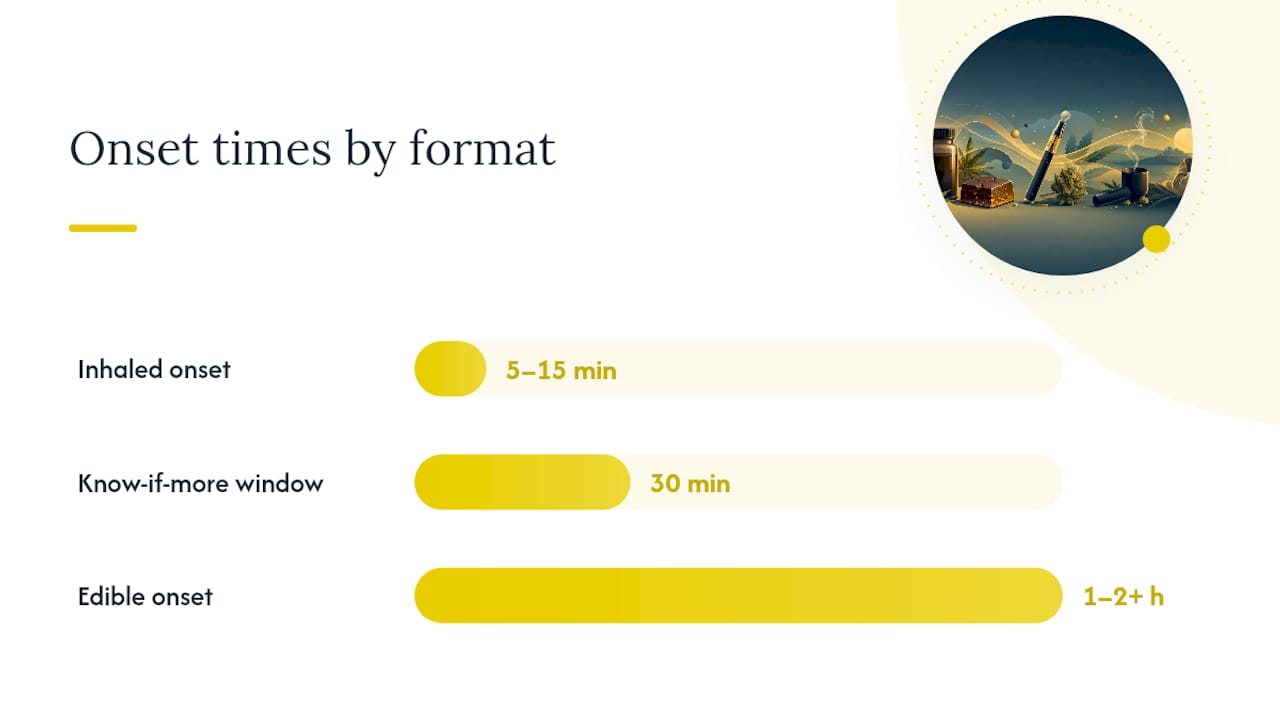
Timing depends heavily on format. Inhaled cannabis, whether flower or a vape, hits within 5 to 15 minutes, so you’ll know within 30 minutes if you need more. Edibles are a different animal entirely: onset can take 1 to 2 hours or longer, and taking a second dose before the first one lands is the single most common way people end up overdoing it.
Pro Tip: Keep a one-line log for the first two weeks: date, product, dose in mg, time taken, and how you slept. Patterns show up fast, and you’ll spot your effective dose before you accidentally blow past it.
If you’re new to comparing cannabinoids directly, this breakdown of THC versus CBD for sleep walks through which one fits which kind of sleep problem.
Flower, Vapes, Edibles, or Tinctures: Which Format Fits Your Sleep Problem
The format you pick should match the problem you’re solving: falling asleep versus staying asleep.
- Flower and vapes hit in 5 to 15 minutes and taper off in 2 to 4 hours, making them the better pick for people who take a long time to fall asleep but don’t wake up repeatedly.
- Edibles take 1 to 2 hours to kick in but last 6 to 8 hours, which suits people who fall asleep fine but wake up at 3 a.m.
- Tinctures and oils land somewhere in between, usually 15 to 45 minutes, and let you dial in dose more precisely than smoking or eating.
- Capsules behave like edibles pharmacokinetically but strip out flavor and combustion entirely, which some people prefer for consistency.
- Combination formats, like 1:1 THC:CBD products or CBN blends with melatonin, are worth considering if straight THC leaves you anxious or straight CBD isn’t doing enough on its own.
The biggest practical hazard with edibles sold legally in Canada isn’t the cannabinoid, it’s serving-size confusion. A package might contain 10 mg total THC split across four gummy pieces, and mistaking “one package” for “one dose” is how people end up with a rough night instead of a good one. For a deeper look at how the two main formats compare on timing and predictability, this edibles versus smoking comparison is worth a read.
What to Actually Check on the Label Before You Buy
“Indica” and “sativa” tell you almost nothing about whether a product will help you sleep. Health Canada’s own clinical guidance treats that classification as an unreliable proxy for sedative effect. What actually predicts a calming outcome is the cannabinoid and terpene profile, and Canadian regulations require licensed producers to disclose that information on the label and in a full certificate of analysis, or COA.
Before adding anything to your cart, check for:
- Exact mg of THC and CBD per serving, not just “% THC” on the front label.
- The CBD:THC ratio, since balanced or CBD-leaning products tend to suit anxiety-driven insomnia better than high-THC ones.
- Whether CBN is listed at all, and at what concentration.
- Terpene data for myrcene, linalool, or beta-caryophyllene, which research on terpene profiles associates with calming effects.
- A publicly available, batch-specific COA rather than a generic one from the brand’s website.
| Sleep scenario | Suggested profile |
|---|---|
| Anxiety-driven insomnia | CBD-dominant or 1:1 CBD:THC, with linalool or myrcene present |
| Pain-related sleep disruption | Balanced or slightly THC-forward, with beta-caryophyllene |
| High THC sensitivity | CBD-only or low-dose CBN blend, minimal THC |
The Risks Nobody Puts on the Front Label
Grogginess, slower reaction time the next morning, and suppressed REM sleep are the most common downsides, and they scale with dose. Cannabis is metabolized through liver enzymes that also process a long list of prescription drugs, so anyone on blood thinners, antidepressants, or sedatives should ask a pharmacist about interactions before combining them. It’s also not a fit for everyone: pregnancy, untreated sleep apnea, and any plan to drive the next morning are reasons to skip it or dose far more conservatively.
Regular nightly use can build tolerance faster than most people expect, requiring higher doses over time to get the same effect on sleep onset. Health Canada is explicit that cannabis is not a first-line treatment for sleep disorders, and persistent insomnia lasting more than a few weeks deserves a real clinical evaluation, not just a bigger dose.
How Bulkcheapweed Approaches Sleep-Focused Products
A typical Canadian cannabis catalog spans flower, edibles, oils, and concentrates at various price points, which matters when you’re trying several low-dose products before landing on the one that actually works for your sleep pattern. The selection approach here prioritizes products with published lab-backed COAs, clear mg-per-serving labeling, and visible terpene panels, the same criteria laid out in the checklist above, rather than leaning on vague indica or sativa marketing. Use that checklist when browsing, and if insomnia has been going on for weeks rather than nights, talk to a clinician alongside whatever you try.
Why Terpenes Beat Strain Names Every Time
The most overrated piece of advice in Canadian cannabis retail is “buy an indica for sleep.” It’s not wrong exactly, it’s just imprecise enough to be useless. Two products labeled indica can have wildly different cannabinoid ratios and terpene content, and one might knock you out while the other does nothing. The evidence points somewhere more specific: dose and cannabinoid ratio predict outcomes far better than strain type ever will.
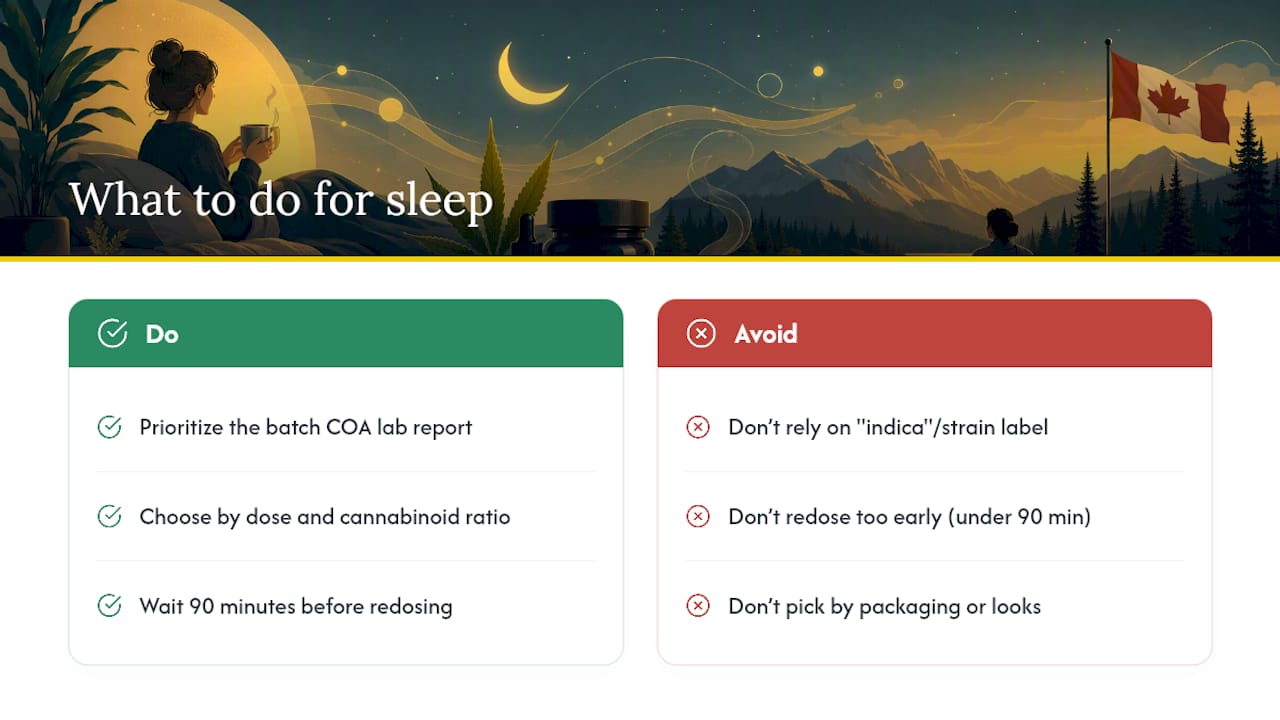
Where conventional advice really falls short is timing discipline. Most people redose edibles too early because nobody tells them clearly that 90 minutes of nothing is normal, not a sign the product failed. That single piece of patience prevents more bad nights than any strain choice does.
If you’re prioritizing one thing, prioritize the COA. A batch-specific lab report showing exact THC, CBD, and terpene content will tell you more about whether a product suits your sleep pattern than any package description. Some catalogs reflect that logic, favoring products where the lab data backs up the label rather than products that just look the part on shelf.
— Supherbs
Ready to Try a Lab-Tested Option Tonight?
Some online retailers offer bulk pricing on lab-tested cannabis products shipped discreetly across Canada, which can make it affordable to try a low-dose CBD oil and a balanced 1:1 edible in the same order instead of gambling on one expensive product and hoping it’s the right fit.
The full shop is organized by product type, so you can filter straight to oils, edibles, or flower depending on which format matches your sleep problem. If you want to understand terpene markers like myrcene and linalool before choosing, the terpenes guide breaks that down in plain language, and the edibles versus smoking comparison is worth a read if you’re still deciding between formats. Always check the COA on whatever you order, and confirm the product is available for shipping to your province before you check out.
This article is general information, not a substitute for advice from a qualified doctor. Consult a qualified healthcare professional about your own circumstances before acting on anything here.
Sources
- Cannabis — Government of Canada
- Review: Cannabis and sleep (PMC review)
- PubMed article on cannabinoids and sleep